Last Updated on: February 3, 2026

When Growth Breaks You Before it Builds You with Dan Sachkowsky
Facebook
Twitter
LinkedIn

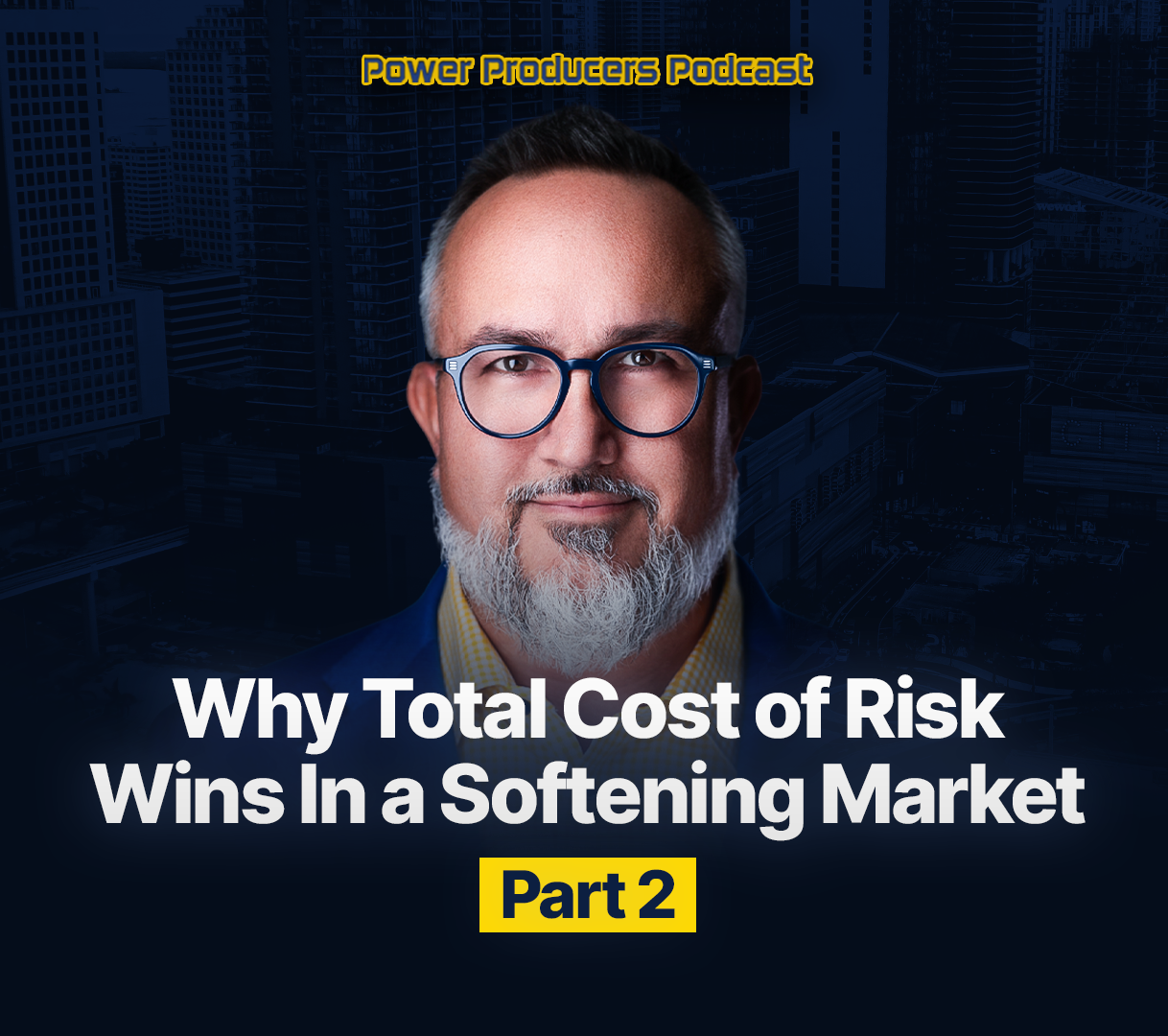
In this episode of Power Producer Shop Talk, host David Carothers delivers a masterclass on navigating the shift from a hard to a soft market, emphasizing that the time to prepare is now. With reinsurance renewals signaling a softening, David warns that the easy “price shopping” wins of the hard market are disappearing, and producers must pivot to value-based selling to displace incumbents who are now delivering good news (rate decreases).

David also breaks down the Total Cost of Risk (TCOR) conversation, explaining why it is the ultimate differentiator for accounts in the $100k-$250k premium range. He details how to uncover “hidden” costs like active vs. passive retained losses and why many businesses are overpaying by acting as their own insurance company without getting the credit for it.

Key Highlights:

The Market Pivot: Hard to Soft

David explains that while the message remains consistent, the delivery must change as we move from a hard market (where incumbents deliver bad news) to a soft market (where they deliver rate decreases). Producers must “sew their seeds” now by cleaning up accounts and focusing on Total Cost of Risk to lock in clients before the next hard cycle hits.

Total Cost of Risk (TCOR) Explained

For producers intimidated by financial jargon, David simplifies TCOR. It’s not just premium—it’s the sum of insurance costs, retained losses, and risk management expenses. He explains that using the word “cost” instead of “price” or “premium” instantly elevates the conversation and positions you as a strategic partner rather than a vendor.

Active vs. Passive Retained Losses

David dives into the nuance of retained losses. An active retained loss is a conscious decision (e.g., a high deductible or choosing not to buy cyber coverage). A passive retained loss is an unexpected hit (e.g., an uncovered claim due to an exclusion). He shares a story of a contractor paying all claims under $5k out of pocket without getting any deductible credit—a massive opportunity for a savvy producer to step in and structure a proper program.

Overcoming Obstacles with Creativity

David shares a personal example of how he handles Department of Defense (DoD) contractors. Since he lacks the security clearance to inspect classified manufacturing areas, he uses a service called Yellowbird to hire ex-military professionals with active clearances to perform the loss control inspections. This creative problem-solving eliminates a major barrier to entry that stops most competitors in their tracks.

The $100k-$250k Sweet Spot

While TCOR works for larger accounts, David argues that the $100k-$250k premium space is the “fertile ground” where this conversation is most effective. These businesses are often large enough to have complex risks but small enough that they haven’t been introduced to sophisticated risk management concepts by their current broker.

Connect with:

Visit Websites:

The Power Producers Podcast where we are refining and redefining the sales game.

Kyle Houck

Producers

Parametric Insurance Explained: How Middle Market Producers Can Hedge Economic Loss, Protect Revenue, and Differentiate at the Point of Sale

The commercial insurance industry is in the middle of a quiet evolution.

While most conversations still revolve around premiums, deductibles, limits, and carrier appetite, a different category of risk transfer has been gaining traction beneath the surface—parametric insurance. It is not new, but it is finally becoming accessible, relevant, and actionable for middle market producers who are willing to think differently about risk.

In a recent episode of the Power Producers Podcast, I sat down with Brian Thompson from Descartes Underwriting to unpack what parametric insurance actually is, what it is not, and why producers who ignore it may be leaving their clients—and themselves—exposed.

This article breaks that conversation down into practical, producer-friendly language and shows how parametric insurance fits into modern middle market risk management.

Read More »

From Bottleneck to Builder: Why Systems, Culture, and Accountability Define Real Business Growth

For most entrepreneurs, the decision to start a business is rooted in the promise of freedom. Freedom from a boss, freedom to control income, and freedom to build something meaningful. Yet for many business owners, particularly in service-based industries and middle-market companies, that freedom slowly erodes. What begins as ownership eventually turns into obligation, where the business demands constant attention and the owner becomes the single point of failure.

Read More »
Cyber

Why Standalone Cyber Insurance Beats BOP Extensions Every Time: Protecting Clients from Modern Threats

The insurance industry is full of shortcuts. Some producers look for ways to streamline the quoting process, others avoid hard conversations with clients, and many rely on endorsements or extensions because they are “easier” than diving into the details. Nowhere is this more dangerous than in the world of cyber insurance.
Too many agents assume that a cyber endorsement on a BOP or commercial package policy is “good enough.” It isn’t. In fact, treating a BOP cyber extension as a replacement for a standalone cyber policy leaves clients dangerously exposed, puts producers at risk of losing accounts, and opens the door to costly errors and omissions (E&O) claims.
Cyber threats evolve faster than any other area of risk, and endorsements simply can’t keep up. If producers want to protect their clients and themselves, it’s time to understand why standalone cyber insurance is non-negotiable.

Read More »

Cyber Insurance Risk Management: Why MFA, MDR, and BYOD Policies Can’t Wait for a Hard Market

The cyber insurance market has softened in recent years. Requirements that were once rigid — like mandatory multi-factor authentication (MFA) or endpoint detection and response (EDR) tools — have been relaxed by many carriers. But here’s the danger: just because carriers aren’t demanding these safeguards today doesn’t mean businesses can afford to ignore them.

Read More »

Test Message

Killing Commercial Login