

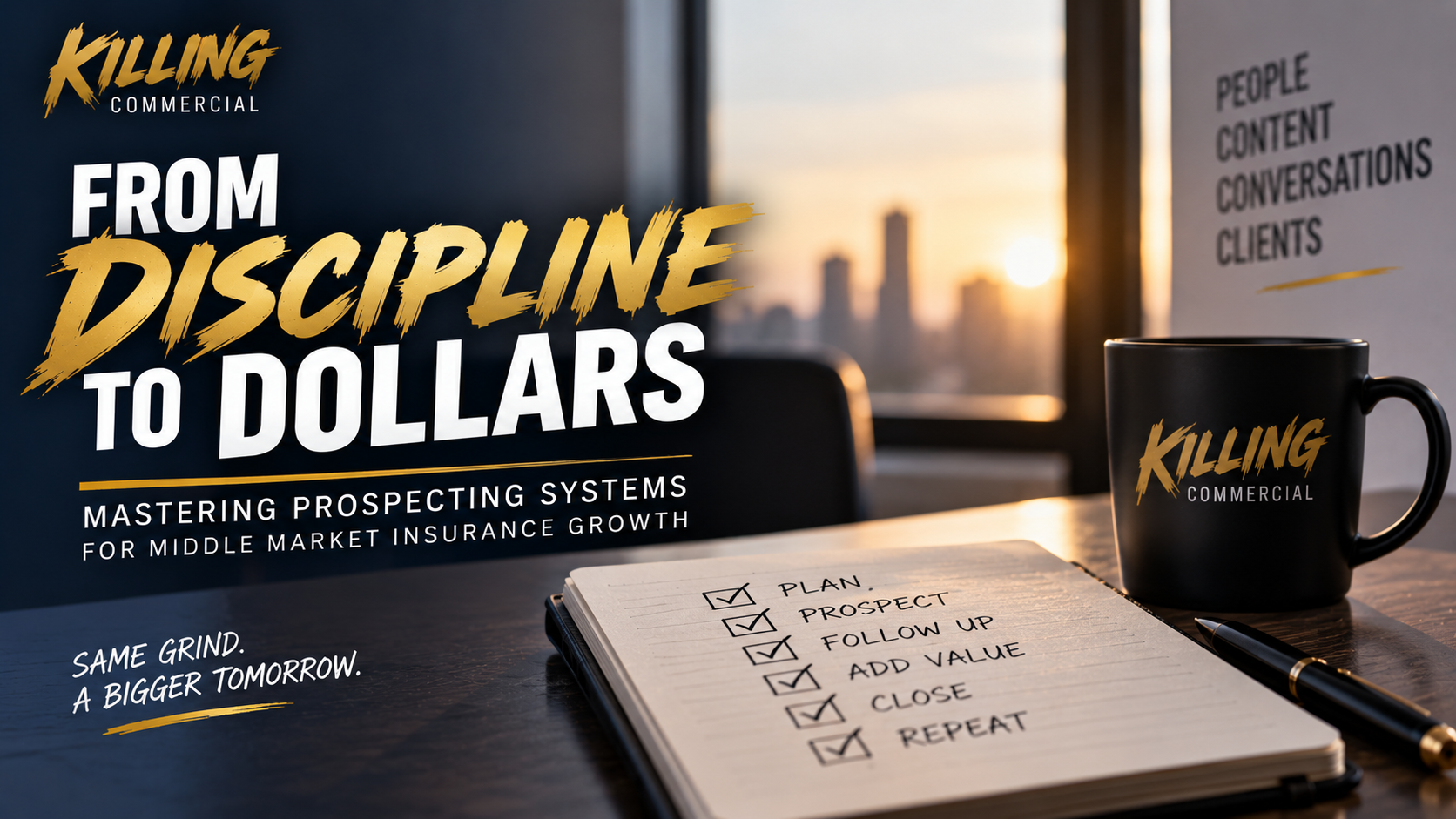
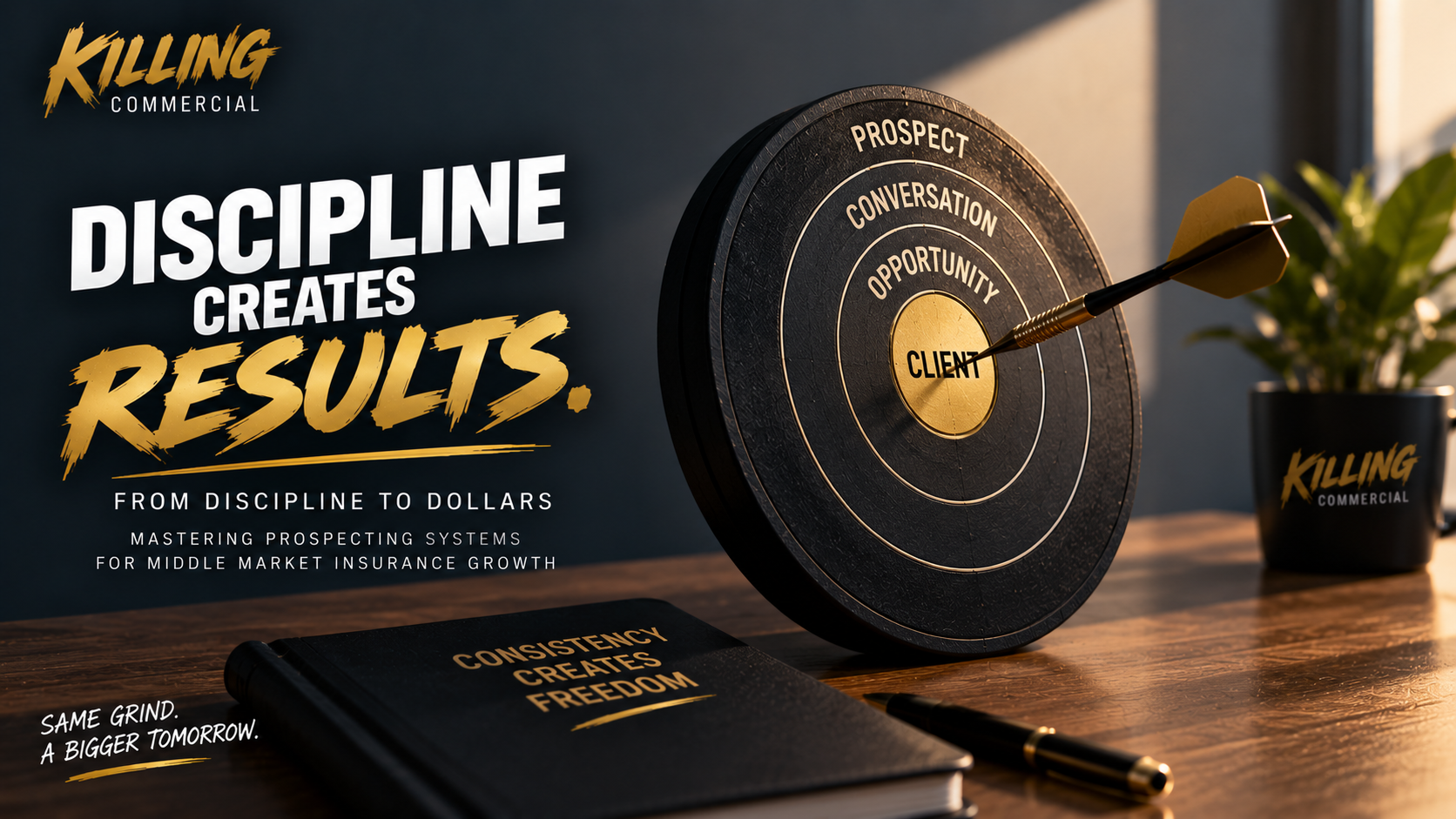

From Discipline to Dollars: Mastering Prospecting Systems for Middle Market Insurance Growth
In the commercial insurance world, producers often think they have a prospecting problem when in reality, they have a discipline problem. It’s not the leads that are lacking—it’s the systems and consistency that drive results over time. If you’re tired of chasing dead ends or feel like you’re spinning your wheels, this post will walk you through how to create a repeatable, scalable prospecting system designed specifically for the middle market.
Let’s break it down from the mindset to the mechanics, and show you how to transform discipline into dollars.
Why Discipline, Not Leads, Is Your Real Prospecting Problem
Ask most struggling producers what their biggest obstacle is, and you’ll likely hear “I need more leads.” But that’s almost never the true issue. The real problem is a lack of consistent execution—what James Clear calls “falling to the level of your systems.” You can have the best leads in the world, but if you don’t show up every day with a plan and follow through, they won’t close themselves.
Discipline is the daily choice to prospect when you don’t feel like it, to follow up even when you’ve already been ghosted, and to continually refine your systems. Like going to the gym, you don’t get results because you bought a membership—you get them because you show up and put in the work.
Without discipline, even the best strategies are worthless. But with it, even the most basic strategies become unstoppable.
Building Your Ideal Prospect Profile
You can’t prospect effectively if you don’t know exactly who you’re trying to reach. That’s why it’s critical to build an Ideal Client Profile (ICP) that defines more than just the industry. Get specific with data: annual revenue, number of employees, number of vehicles in the fleet, experience mod score, and scope of operations.
For example, a winning ICP in Florida might focus on residential service contractors—plumbers, electricians, HVAC companies—with:
• $5 million or more in revenue
• 25+ commercial vehicles
• 40+ employees
• Mod of 1.0 or higher
These accounts are operationally consistent, have fewer cert requests due to residential-only work, and are underserved by agents who focus only on quoting instead of risk strategy. Even if the premium may vary across geographies like Tampa or Columbus, the structure of the account remains stable—making your systems repeatable.
When you know who your ideal client is, your entire pipeline becomes more focused—and your messaging becomes significantly more effective.
Why Insurance Isn’t the Wedge—Risk Insights Are
If you’re leading with insurance, you’re already losing. Smart middle market producers know the real wedge is identifying and solving operational risks before they become costly losses. That’s where your opportunity lies—not in quoting faster or cheaper.
Instead of showing up with a quote sheet, imagine walking in with:
- Ladder safety inspection stickers
- A printed OSHA standard
- Benchmarking data on industry compliance
- A training guide on how to implement a ladder inspection program
These are not just leave-behinds—they’re value assets that position you as an expert, not a salesperson. This wedge strategy turns cold drops into warm conversations and helps you build credibility with decision-makers before you ever discuss coverage.
When you help a business avoid losses, you’re influencing the outcome of their premium—not just shopping it around. That’s how you become irreplaceable.
Systematic Prospecting: Multi-Channel Outreach That Works
Cold calling isn’t dead—but it can’t be your only tactic. Producers who win are those who use a multi-channel approach that includes:
- Phone calls
- Email sequences
- Direct mail
- Paid ads
- Content marketing
- Social media engagement
- In-person marketing drops
Each of these channels creates micro-touchpoints that build brand awareness and trust over time. But to do this effectively, you need systems. Use platforms like InsuranceXdate or Reference USA to build your lead lists. Hire virtual assistants to handle appointment setting and data mining. Pre-schedule your social content and email campaigns.
The most important factor is consistency. Block time each week for outreach and stick to it. Prospecting only when your pipeline is empty is the equivalent of only going to the gym when you gain weight. Build the habit, and your pipeline will fill itself.
LinkedIn Prospecting Without the Cringe
LinkedIn can be a goldmine—if you use it right. Most producers treat it like a shortcut to pitch, which ruins the experience for everyone. Here’s a better way:
- Send a personalized message with each connection request
- Find a common interest or shared network
- Follow their content for a few weeks before engaging
- Leave a thoughtful comment or send a voice/video message to stand out
Your goal on LinkedIn isn’t to close deals—it’s to build familiarity and credibility. People buy from those they trust, and trust is earned over time. Don’t spam people. Instead, interact like a real human.
When you finally show up in their inbox with value, they’ll remember you—and you’ll have earned the right to ask for time.
Building and Refining Your Pipeline with Purpose
Your pipeline should never be an unfiltered spreadsheet. Build it with intention:
- Use search parameters based on your ICP: industry, geography, employee count, sales volume
- Adjust filters strategically to maintain quality (i.e., lower employee count before lowering revenue)
- Use data platforms or state websites to identify active workers comp policies and X-dates
Bonus Tip: In Florida, you can access workers comp policy data directly through the Department of Financial Services. Filter by expiration month, then refine by class code (e.g., 5183 for plumbers).
You can also subscribe to NCCI to be notified when a mod is updated—giving you a real-time list of businesses experiencing rate changes. That’s a high-value trigger for outreach that most producers ignore.
Drop Strategies That Drive Engagement
Your marketing drop should do two things:
- Deliver immediate value
- Give you a reason to return
Examples of successful drops include:
- Branded folders with personalized letters and OSHA collateral
- Ladder inspection stickers and training documentation
- Gummy bear jars or coffee mugs with a refill promise
- Bureau of Labor Statistics reports showing wage benchmarks
Tell the receptionist, “When this runs out, let me know and I’ll bring you more.” That simple line opens the door for a second visit, which could lead to the meeting you need.
Most producers drop off generic brochures and hope someone calls them back. Don’t be most producers.
Make It Easy to Say Yes: Ask Better Questions
One of the best ways to differentiate yourself is by asking smarter questions that lead prospects to self-discover their weaknesses. Instead of telling a prospect they don’t have a return-to-work program, ask:
“Out of curiosity, what does your claims process look like when someone gets injured on the job?”
Or instead of pointing out that their mod is rising, ask:
“When you had your mid-year claims review before your unit stat cards were submitted, what strategies did you and your agent use to reduce your total incurred?”
Let them come to the conclusion. That way, you’re not attacking their current agent—you’re helping them realize a better way exists.
How to Use Technology to Become Uncommon in a Common Marketplace
Modern producers should be leveraging technology every step of the way:
- Use ChatGPT to create niche messaging and content based on your past experience
- Use NCCI notifications to build your daily call list
- Use CRM tools to track lead progress and automate follow-up
- Use video to create personal touchpoints on LinkedIn or email
These tools aren’t optional anymore—they’re part of the new sales landscape. The producers who embrace them will win. The ones who don’t will be replaced.
Closing Thoughts: From Leads to Loyalty
If you take only one thing away from this blog, let it be this:
You don’t need more leads. What you need are better habits.
Start by creating a system and defining your ICP. Then use value-based wedges, follow a consistent cadence, and personalize your drops. Most of all, prospect with purpose—not desperation.
When you lead with education, insight, and empathy, you don’t just win accounts—you build relationships that last for years.
And that’s how you go from discipline… to dollars.
When you lead with education, insight, and empathy, you don’t just win accounts—you build relationships that last for years.
And that’s how you go from discipline… to dollars.

Resiliency Over Reaction: Educating Insurance Buyers in a Hardening Market
Insurance agents are facing an unprecedented climate—literally and figuratively. Rates are climbing, carriers are exiting markets, and clients are more frustrated than ever. In states like Florida, where the insurance industry has been grappling with catastrophe exposure and claim volatility for decades, these challenges are nothing new. But for the rest of the country, the learning curve is steep—and accelerating.

From Door Knocks to Risk Strategy: How to Prospect, Differentiate, and Win in the Middle Market
In the world of commercial insurance, middle market producers are feeling the crunch. Renewals are taking more time than ever, prospecting often gets pushed aside,

From Discipline to Dollars: Mastering Prospecting Systems for Middle Market Insurance Growth
In the commercial insurance world, producers often think they have a prospecting problem when in reality, they have a discipline problem. It’s not the leads

From Booth to Business: Leveraging Trade Shows and Referral Partners to Grow Your Middle Market Pipeline
Trade shows and referral networks are often overlooked in today’s digital-first world. But if you’re a commercial insurance producer focused on the middle market, these

From Cold Drops to Commission Growth: Prospecting Systems that Win in the Middle Market
In the hard market we’re navigating today, traditional prospecting methods aren’t cutting it anymore. Cold calls are tougher, marketing drops feel outdated, and clients are

How Insurance Producers Can Dominate Digital Prospecting with Personal Branding, Niche Content, and Smart Automation
In the competitive world of commercial insurance sales, standing out isn’t just a nice-to-have—it’s essential. As traditional cold calling yields fewer returns and digital channels
Responses