
AI for Insurance Agencies: How Better Processes Give Producers More Time to Sell and Advise

Saving time means little if the client never experiences the benefit.
An agency can automate renewal preparation, organize information faster, and reduce repetitive work. The bigger opportunity is what producers do with that capacity.
Do they ask better questions? Explain coverage more clearly? Spend time helping a business owner prepare for what comes next?
That is where AI for insurance agencies becomes a conversation about growth and service.
In this episode of the Power Producers Podcast, David Carothers sits down with Colby Tunick of Refocus AI to discuss renewal automation, agency workflows, and the human side of adopting technology.
Their conversation moves between personal lines, small commercial, and lessons that apply across the agency.
One point connects it all.
Technology should give producers more room to use their expertise and build relationships. That requires a process worth automating.
Solve the Renewal Problem Before It Becomes Overwhelming
David explains that his agency began evaluating renewal technology before it had a large personal lines renewal book.
That timing was deliberate.
He could see where the agency was heading and wanted time to implement the tools, test the workflow, and address problems before volume increased.
Waiting until renewals became overwhelming would have made the same work more difficult.
Colby describes Refocus as a servicing automation platform focused primarily on personal lines at the time of the conversation. He presents its goal as reducing a renewal workflow from roughly 90 minutes to about 20 minutes.
Those figures are Colby’s description of the platform’s value, rather than a guaranteed result for every agency.
David focuses on the practical implication: reducing preparation time creates room for a better renewal conversation.
For agency owners, the starting question is useful regardless of the tool.
Which recurring task will become harder to manage as the book grows?
Identify that task while there is still time to improve it thoughtfully.
A More Balanced Book Requires a Sustainable Service Model
David also explains why personal lines and small commercial had become priorities for his agency.
Larger accounts can generate substantial revenue. However, losing a few through acquisitions or other changes can leave a noticeable hole in the book.
His goal was to build a broader foundation of smaller relationships alongside middle market business.
That strategy creates an operational challenge.
More accounts mean more renewals, service requests, and opportunities for follow-up. The agency needs a way to support those relationships without making every transaction depend on lengthy manual work.
Colby connects this issue to the economics of servicing personal lines. An account can require meaningful attention even when the commission is relatively modest.
Automation becomes useful when it helps the agency serve that business consistently.
The lesson is to connect growth plans with service capacity. Before pursuing more volume, understand how the team will handle the work that follows.
Use Existing Relationships to Start Broader Conversations
David describes how his personal lines expansion began with requests for standalone umbrella coverage.
Those initial relationships gave the agency a starting point. Later, as its capabilities expanded, the team could ask about reviewing home and auto coverage as well.
The conversation had a clear reason behind it: the agency could now help in ways it could not before.
That example illustrates how growth can develop within an existing book.
However, the opportunity still requires someone to ask.
A client who buys one policy may not know what else the agency handles. Similarly, a business owner may keep personal and commercial insurance separate without considering whether an advisor should review the broader picture.
David describes making the agency’s capabilities part of the conversation.
For producers, the practical application is to ask whether a wider review would be useful and explain why.
A relevant cross-selling conversation begins with the client’s circumstances.
Technology can help organize the opportunity. The producer still needs to connect it to a meaningful need.
Start With AI Tasks You Can Review
David shares several examples of using AI to reduce time spent organizing information.
For Producers in Paradise, he describes combining registration spreadsheets and sorting attendees by activities, names, and shirt sizes.
He also discusses aggregating payroll information by class code to support a projection. In that example, he says the reports did not include personally identifiable information.
Another use case involves organizing loss information and identifying patterns for further review.
These examples have a common feature: the requested output is specific.
Instead of asking a tool to solve an undefined business problem, David gives it a task such as combining records, grouping information, or highlighting trends.
That creates a clearer basis for checking the result.
For an agency, a practical starting point is work where the team understands the source material and can recognize mistakes. Use appropriately handled data and keep review connected to the workflow.
An organized summary can support professional judgment. It should not quietly become a substitute for that judgment.
Insurance Knowledge Still Matters
Colby describes general-purpose AI as a generalist.
It can be helpful with tasks that appear across many contexts, including organizing documents and summarizing information. Insurance-specific work introduces additional considerations.
During the episode, he discusses sharing reusable AI skills intended to add insurance knowledge and guardrails to common tasks.
His broader point is that better instructions and relevant context matter.
A polished answer can still miss something important. Likewise, a suggested pattern in loss information may deserve investigation before it becomes a recommendation.
David’s approach reflects that distinction. He wants help preparing and organizing the work while continuing to focus on being an agency owner and commercial producer.
For leaders, this creates a useful standard.
Define what the tool prepares and what the professional must evaluate.
That separation makes it easier to explain responsibilities, train the team, and review the quality of the output.
A Quick Prototype Is Different From an Agency Workflow
David describes experimenting with a proposal tool while waiting for a meeting.
Within a short period, he had a basic version that could turn a quote into a branded presentation. The result impressed him, although the formatting still needed work.
He also makes clear that he was not using that prototype in the agency.
Instead, the agency was using a proposal feature available through another product it already had.
That distinction matters.
Building a demonstration can help an owner explore an idea. Using something consistently with clients requires attention to accuracy, formatting, handoffs, and the people responsible for maintaining it.
The practical question is whether building the tool improves the operation enough to justify that work.
Sometimes an existing feature already addresses the need.
Before creating another system, review what the agency owns and how effectively the team uses it. A tool that fits the current workflow may be more useful than another project to manage.
Evaluate AI for Insurance Agencies by the Problem It Solves
David expresses concern about products that begin with one strong capability and then add numerous peripheral features.
Additional functions can be convenient. They can also make it harder to understand what the agency actually needs.
His approach is to step back and ask which problem a product solves.
That question helps keep technology decisions connected to the business.
An agency might need faster renewal preparation, a better phone intake process, or less duplicate entry between systems. Each is more concrete than a general desire to “use more AI.”
Integration deserves similar attention.
When information passes between tools, someone must understand what moves, where it goes, and what happens next. Turning on a connection does not necessarily create a complete workflow.
Choose technology around a defined need, then design how the team will use it.
That gives implementation a clearer purpose and makes results easier to assess.
Reinvest Saved Time in Better Advice
One of the strongest moments in the episode concerns a conversation David had with a new business owner.
The account was relatively small, but the owner needed guidance about getting started and preparing for future growth.
David describes having enough capacity to explain what deserved attention immediately and what could be planned for later.
The client valued that education.
According to David, the owner also recognized that he would not have known which questions to ask an AI tool. Experience helped David anticipate issues the client had not yet considered.
That is a practical example of how automation can support a human relationship.
Less time spent on repetitive work gave him more freedom to stay in the conversation.
For producers, the opportunity is to make that reinvestment deliberate. Use some of the time recovered from preparation to explain recommendations, ask follow-up questions, and help clients understand their choices.
Efficiency becomes more meaningful when it improves the advice.
A Streamlined Process Can Still Damage the Client Experience
Colby offers a contrasting example from his own insurance experience.
His business had developed a relationship with a producer who understood its needs, including international exposures.
Then the brokerage told him the account would move to a small-business service team because it fell below a commission threshold.
Colby describes uncertainty about the transition and the loss of a familiar point of contact. As a result, his business began looking elsewhere.
The example does not establish that every centralized service model creates a poor experience. It shows what can happen when the client feels the relationship has been removed without a satisfactory replacement.
For agency owners, that is an important consideration when redesigning service.
Will the customer know whom to contact? Does the next team understand the account? Has anyone explained what the change means?
A more efficient internal arrangement should still make sense to the person buying the insurance.
Document the Process Before Adding Automation
David compares the current enthusiasm for AI with the earlier rush to hire virtual professionals.
In both situations, agencies can become excited about the resource before defining the work.
A virtual employee may know an agency management system but still need training on the agency’s configuration and procedures. An AI tool likewise needs a clear role within the operation.
David describes reviewing his agency’s HubSpot workflows while introducing another tool.
The team had to examine individual stages of the process and decide how the new capability should support them. It was more involved than simply allowing data to pass between systems.
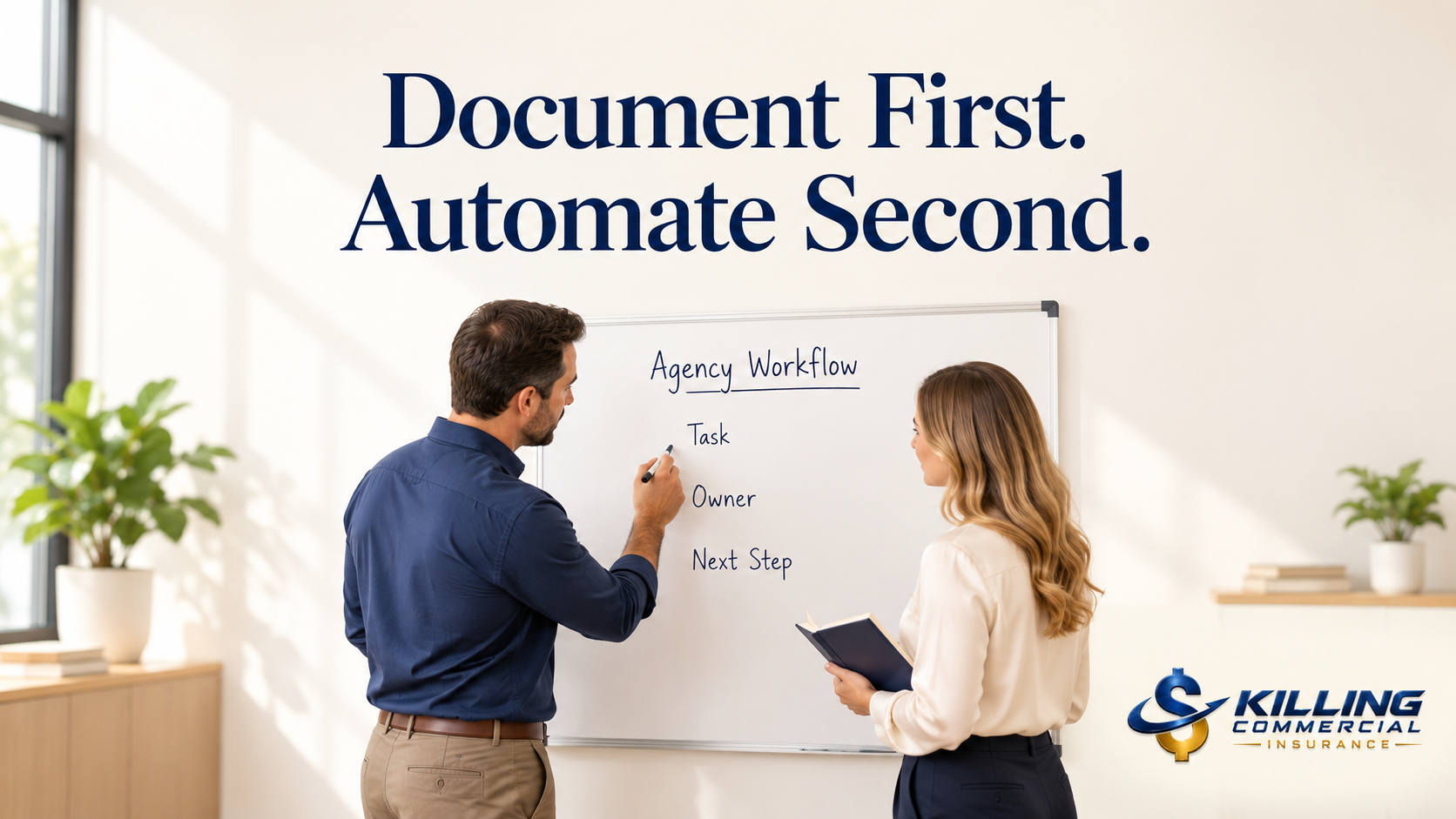
Colby reinforces the underlying problem: technology cannot resolve an environment where everyone performs the same task differently and nothing is documented.
Standard operating procedures provide a starting point.
They should explain what triggers the work, who owns it, what information is required, and what a completed task looks like.
Without those answers, automation can make existing confusion harder to manage.
Improve One Part of the Workflow at a Time
Documenting an entire agency can feel overwhelming, particularly when new opportunities and service requests keep arriving.
David describes addressing that challenge by blocking calendar time and dividing larger processes into smaller segments.
The team starts with a broad view, then works through specific portions in more detail.
This approach makes the work easier to continue.
A useful starting point might be the handoff from an incoming inquiry to the first producer conversation. Another could be the transition from renewal preparation to client review.
For each segment, ask:
What information must be available?
Who is responsible for the next action?
Where does the team record completion?
What happens when something is missing?
These questions turn a broad improvement goal into work the team can actually finish.
Some processes need refinement. Others must be defined before they can be tested.
Progress depends on making that distinction and continuing the work.
Check the Details at the Human Handoff
David shares a small example of improving an AI-supported intake process.
An AI phone attendant was capturing calls, but occasional errors appeared in names and email addresses.
Rather than dismissing those mistakes, he adjusted the team’s follow-up.
At the beginning of the next conversation, the employee would confirm the spelling of the caller’s name and verify the email address.
That added a simple quality check where a human was already involved.
The example shows how useful refinement often happens after implementation. A tool may perform well overall while still revealing a recurring issue worth addressing.
For agency owners, the response should be specific.
Identify the error, decide where it can be caught, and make that check part of the process.
Using technology well includes noticing where the workflow still needs human attention.
Build an Agency Where Technology Supports the Relationship
David and Colby’s conversation returns repeatedly to the same purpose.
Renewal automation should create capacity for better discussions. Organized data should help professionals prepare. Clear workflows should make service more consistent.
The value extends beyond completing administrative tasks faster.
It shows up when a producer has time to explain a recommendation, when a client knows whom to contact, and when the agency follows through without depending on memory.
For owners considering AI for insurance agencies, the next step can be modest.
Choose one recurring workflow. Document how it operates today. Identify the repetitive work, the review points, and the client conversation it should support.
Then evaluate whether technology can improve that process.
The goal is an agency where producers have more time to advise, clients receive a better experience, and growth rests on work the team can repeat.

Insurance Intake Automation: How Better Data Creates Better Client Conversations
A prospect agrees to talk about insurance. Then the work begins: locating declarations pages, answering questions, sending documents, and repeating information that already exists somewhere

Value-Based Selling in Insurance: How Guffy Wright Creates Client Alignment
Guffy Wright thought he had presented an offer that would be difficult to refuse. His insurance proposal was approximately $2 million less expensive, and he

Leadership Skills for Insurance Producers: Building Confidence, Making Better Decisions, and Understanding People
Sitting in a prospect’s parking lot, David Carothers started questioning whether he belonged inside the building. The company was a significant opportunity. Its operations were

Commercial Insurance Prospecting: How Better Data Creates Better Producers
A renewal date tells you when to call a business. It does not necessarily tell you why the owner should take the call. That difference

Relationship Building in Sales: The Human Advantage in the Age of AI
A baseball card tucked inside a thank-you note would be easy to overlook. For Patrick Galvin, it became a reason to return to a mortgage

AI for Insurance Agencies: How Better Processes Give Producers More Time to Sell and Advise
Saving time means little if the client never experiences the benefit. An agency can automate renewal preparation, organize information faster, and reduce repetitive work. The
Responses