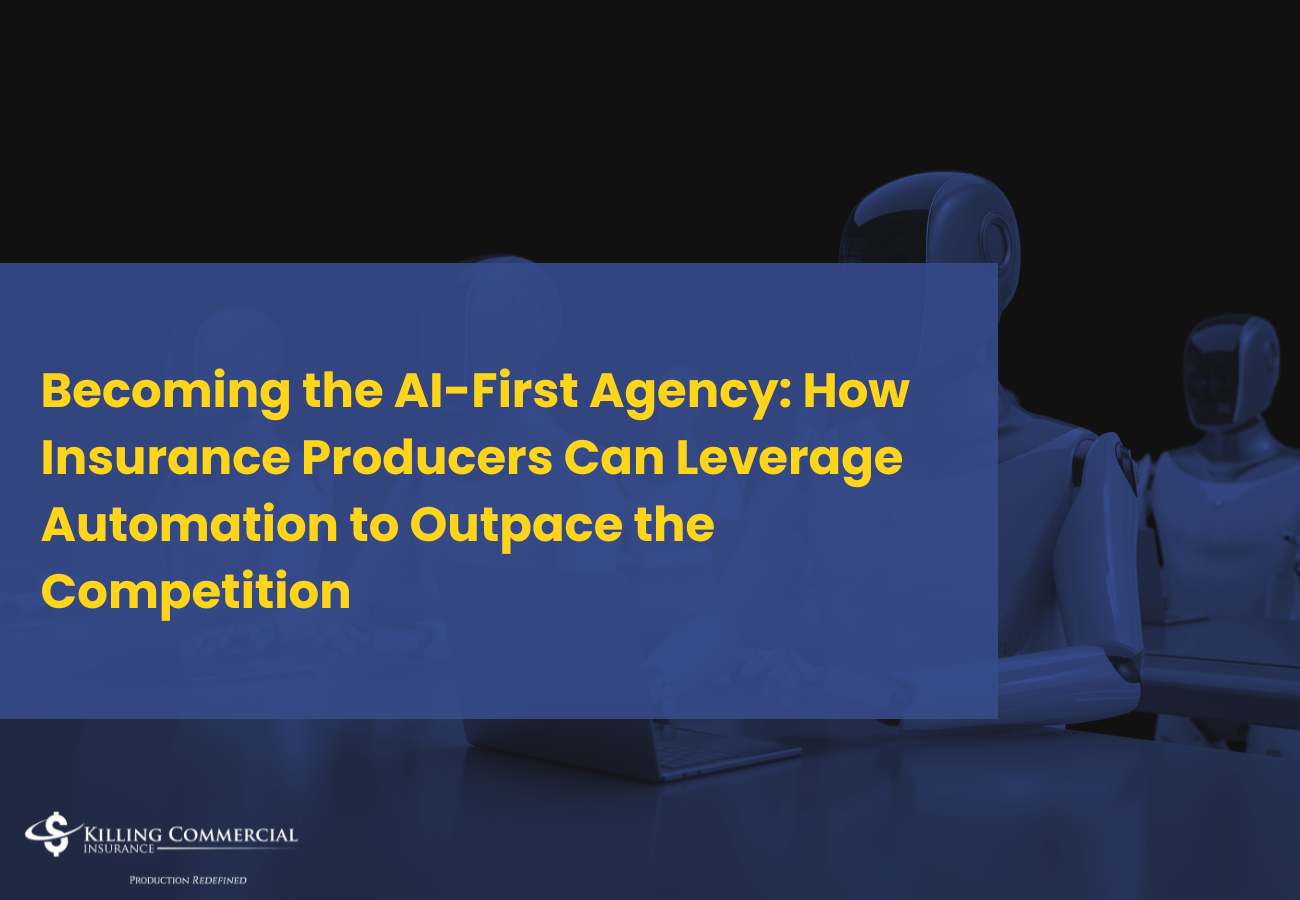


Becoming the AI-First Agency: How Insurance Producers Can Leverage Automation to Outpace the Competition

AI AGENCY

Artificial Intelligence is no longer a buzzword for tomorrow. It’s today’s most powerful tool for increasing efficiency, lowering costs, and growing your book of business faster than ever before. For insurance producers and agency owners, this isn’t a matter of curiosity or a “nice to have” anymore. It’s a necessity. The reality is that your competition may already be using AI-powered tools to identify prospects, streamline service, and close deals before you even realize you’re in the game.

Kevin Surace from Appvance, one of the pioneers of virtual assistant technology and a leading voice in AI development, puts it bluntly: “You want to be the robot overlord, not get run over by the darn thing.”

AI is already being used at scale by carriers, brokers, and agencies to automate everything from claims processing to client communication. And while some fear it may replace human jobs, the truth is more nuanced: it replaces inefficiency, not value. The producers who thrive going forward will be those who learn to amplify their expertise through technology.

Amplifying Sales Efficiency with Generative AI

Imagine this: You walk into a meeting with the CFO of a $50 million manufacturing company. Before you even stepped into the room, AI helped you:

  • Research the company and identify its key risk exposures
  • Generate a list of the most relevant coverage gaps
  • Script your discovery questions based on the CFO’s likely concerns
  • Prepare answers to the questions they will ask you

This isn’t science fiction. It’s what smart producers are already doing today. Generative AI can analyze thousands of similar businesses and surface insights that would take a human hours to find. Tools like custom-trained GPTs allow you to plug in your agency’s voice, your FAQs, your sales objections, and your thought leadership content to become a real-time assistant.

Even more impressive? AI can poke holes in your own pitch. By feeding it your current value proposition, it can return better differentiators, potential objections, and messaging improvements, making sure you’re always one step ahead.

In an industry where timing and differentiation are everything, generative AI is your cheat code to better prospecting and faster pipeline movement.

Real-Time Quoting and Proposal Generation: Closing While the Prospect Is Hot

One of the most frustrating things in commercial insurance is how long it takes to get quotes. By the time underwriting cycles churn through submissions, meetings are held, and approvals are given, the prospect has either gone cold or your competitor has already bound coverage.

AI is changing that. Advanced platforms can now generate accurate quotes in minutes by analyzing historical loss data, risk indicators, and similar accounts. This real-time quoting technology enables producers to:

  • Deliver proposals while still on-site
  • Enter rate discussions when interest is highest
  • Reduce delays that cost deals

As Kevin Surace noted, “Give the producer a quote in five minutes while the prospect is hot, and you will close more business. Period.”

With predictive underwriting and quote generation becoming more reliable, producers can move from reactive to proactive in how they sell. And if a mistake happens? You retain the right to re-rate later, but 98% of the time, the quote will be spot on.

Automating Content Creation and Marketing with AI

You know you should be marketing your agency with content, but who has time? AI solves that too.

Here’s an example of a complete content flywheel:

  • Use a tool like Otter.ai to transcribe a podcast or client call
  • Feed the transcript into ChatGPT to create a summary, blog outline, and social media posts
  • Generate a full blog post using a custom GPT trained on your voice and past work
  • Repurpose the content into a video script, email campaign, or newsletter

This workflow, which used to take 6+ hours and a virtual assistant, can now be done in under 10 minutes.

AI gives producers the power to create at scale without sacrificing quality. From drip campaigns and proposal videos to automated client newsletters and onboarding sequences, you can stay top-of-mind without staying chained to your desk.

Claims Processing, Customer Support, and the AI Agent Takeover

Let’s talk about service.

AI is revolutionizing the claims experience. One example from Japan demonstrates full claim adjudication happening in under 15 minutes — no human involvement. A picture is submitted, AI validates it, checks the policy, looks at the claim history, and ACHs the payout.

In the U.S., we’re starting to see carriers and MGAs deploy similar AI-powered claims triage systems that:

  • Eliminate fraud through photo recognition
  • Shorten cycle time
  • Reduce the need for multiple human adjusters

In customer support, AI voice agents are replacing chatbots and IVRs. With natural voice cloning, your AI agent can sound just like you, respond to FAQs, guide clients through policy changes, and even upsell coverage. And yes, if someone needs a human, they can be transferred seamlessly.

Consumers want instant gratification. AI agents provide that while maintaining the knowledge base and tone of your agency.

Rethinking Your Agency Model with AI and Virtual Teams

This is the part that scares traditionalists.

David Carothers said it best: “We’re in an age where a single producing agent can build a $10 million revenue agency with no other producers.”

How? Through:

  • Real-time data mining and lead generation tools
  • Robotic process automation (RPA) to handle submissions and quote requests
  • AI voice and video agents to conduct sales presentations
  • Offshore or remote virtual professionals for account management
AI AGENCY

The agency of the future is lean, tech-driven, and scalable. You’re no longer limited by your zip code when hiring talent or targeting clients. AI extends your capabilities far beyond what was previously possible.

Transactional lines like pet insurance, renters, and flood can now be treated like affiliate income streams. Serve ads at the point of need, automate fulfillment, and bank recurring revenue — no manual effort required.

Avoiding the Pitfalls: Human Touchpoints Still Matter

AI isn’t about removing humans from the process altogether. It’s about removing friction.

There are still moments where the personal touch matters: claims disputes, high-complexity commercial placements, consultative reviews. But now, your time is freed up to focus on those areas because AI handled the rest.

The key is to train your AI agent or workflow using your real content, your real FAQs, and your real tone. When clients engage, they should feel they’re talking to you — not a robotic script.

Use AI to enhance your human moments, not replace them.

Final Thoughts: Train Has Left the Station — Are You On It?

Whether you’re ready or not, the AI revolution is in full swing. Your competition might already be using these tools. If they are, they’re:

  • Closing deals faster
  • Generating more leads
  • Providing better service
  • Spending less time on admin
  • Growing their books at a pace you can’t match manually

The train has left the station. Some producers are on board. Others are watching it disappear.

Which are you?

You don’t need to become a coder or a futurist to win. You just need to start:

  • Build a custom GPT trained on your content
  • Use voice cloning and avatars for sales videos and web engagement
  • Automate quote-to-bind workflows
  • Add virtual agents to your website
  • Personalize your marketing with AI segmentation

As Kevin Surace said, “Everything we’ve talked about today is not the future. It’s here.”

Producers

Parametric Insurance Explained: How Middle Market Producers Can Hedge Economic Loss, Protect Revenue, and Differentiate at the Point of Sale

The commercial insurance industry is in the middle of a quiet evolution.

While most conversations still revolve around premiums, deductibles, limits, and carrier appetite, a different category of risk transfer has been gaining traction beneath the surface—parametric insurance. It is not new, but it is finally becoming accessible, relevant, and actionable for middle market producers who are willing to think differently about risk.

In a recent episode of the Power Producers Podcast, I sat down with Brian Thompson from Descartes Underwriting to unpack what parametric insurance actually is, what it is not, and why producers who ignore it may be leaving their clients—and themselves—exposed.

This article breaks that conversation down into practical, producer-friendly language and shows how parametric insurance fits into modern middle market risk management.
Read More »

From Bottleneck to Builder: Why Systems, Culture, and Accountability Define Real Business Growth

For most entrepreneurs, the decision to start a business is rooted in the promise of freedom. Freedom from a boss, freedom to control income, and freedom to build something meaningful. Yet for many business owners, particularly in service-based industries and middle-market companies, that freedom slowly erodes. What begins as ownership eventually turns into obligation, where the business demands constant attention and the owner becomes the single point of failure.

Read More »
Cyber

Why Standalone Cyber Insurance Beats BOP Extensions Every Time: Protecting Clients from Modern Threats

The insurance industry is full of shortcuts. Some producers look for ways to streamline the quoting process, others avoid hard conversations with clients, and many rely on endorsements or extensions because they are “easier” than diving into the details. Nowhere is this more dangerous than in the world of cyber insurance.
Too many agents assume that a cyber endorsement on a BOP or commercial package policy is “good enough.” It isn’t. In fact, treating a BOP cyber extension as a replacement for a standalone cyber policy leaves clients dangerously exposed, puts producers at risk of losing accounts, and opens the door to costly errors and omissions (E&O) claims.
Cyber threats evolve faster than any other area of risk, and endorsements simply can’t keep up. If producers want to protect their clients and themselves, it’s time to understand why standalone cyber insurance is non-negotiable.

Read More »

Cyber Insurance Risk Management: Why MFA, MDR, and BYOD Policies Can’t Wait for a Hard Market

The cyber insurance market has softened in recent years. Requirements that were once rigid — like mandatory multi-factor authentication (MFA) or endpoint detection and response (EDR) tools — have been relaxed by many carriers. But here’s the danger: just because carriers aren’t demanding these safeguards today doesn’t mean businesses can afford to ignore them.

Read More »

Responses

Test Message

Killing Commercial Login