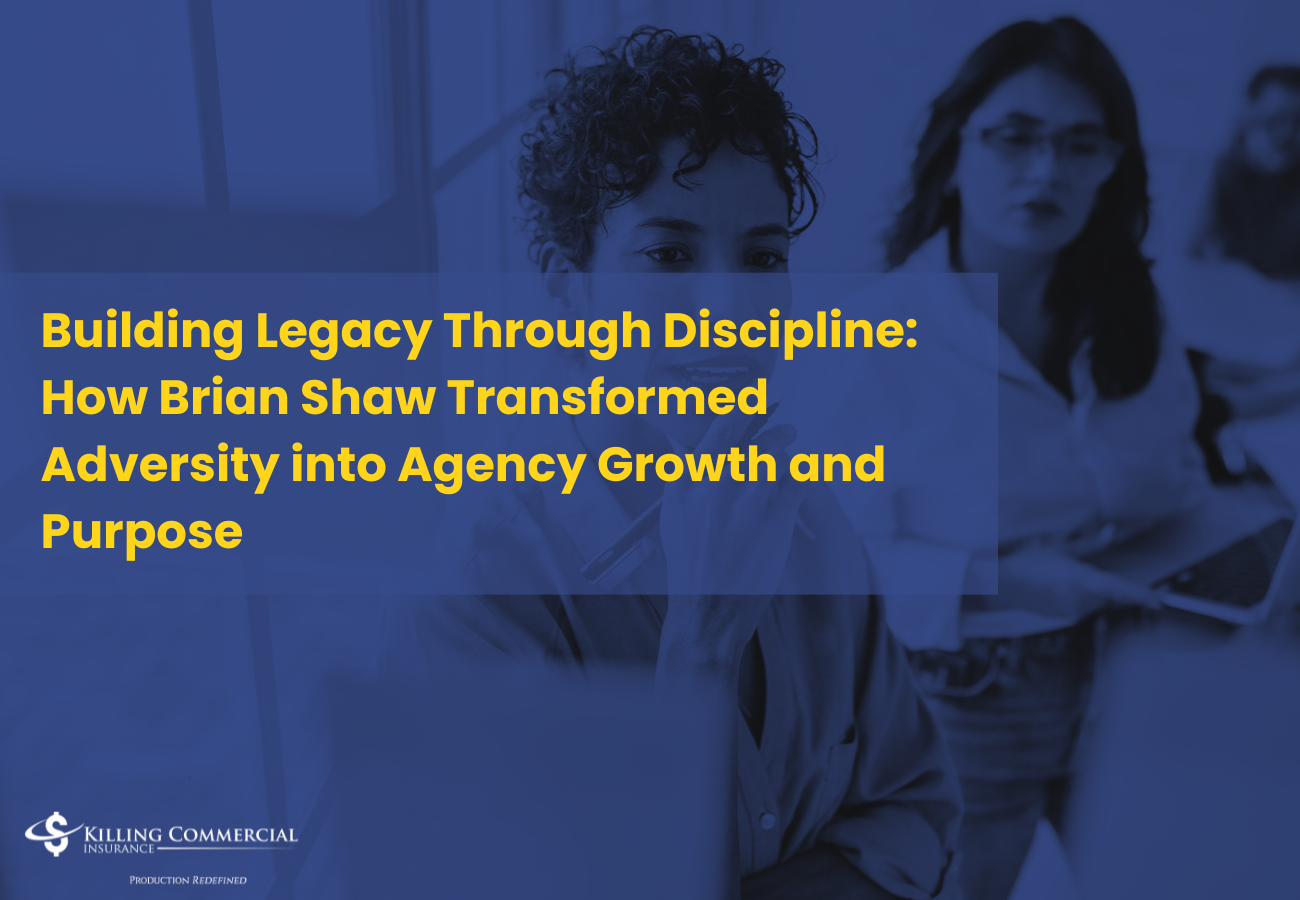

Building Legacy Through Discipline: How Brian Shaw Transformed Adversity into Agency Growth and Purpose

growth

There are few things more powerful than a story of growth, redemption, resilience, and responsibility — especially when that story is rooted in family and legacy. On the Power Producers Podcast, I had the opportunity to sit down with Brian Shaw, the Principal of Alamo Insurance Professionals in Texas, and a contestant in Becoming The Protege: Season 3.

Brian’s journey isn’t one of shortcuts or overnight success. Instead, it’s the story of a man who has faced battlefields, boardrooms, and hospital beds — and through it all come out the other side with an unshakable sense of purpose. Along the way, every challenge has refined his focus and strengthened his resolve. His agency is young, yet his vision is clear, and ultimately his “why” runs deep.

This episode wasn’t just about insurance. It was about fatherhood, discipline, and building something that will outlast you.

From Service to Sales — The Path That Forged a Leader

Brian’s professional journey started long before he ever thought about premiums, policies, or producers. Right after graduating high school, he enlisted in the U.S. Army, serving five years as a Military Policeman. During this time, the structure, accountability, and mission-driven mindset he developed gradually began to shape his character. As a result, those experiences didn’t just influence how he saw the world — they defined it. Ultimately, that experience laid the foundation for how he would later on lead his agency.

After his military service, he then transitioned into law enforcement, working for the sheriff’s department while attending school full-time. During those years, he learned how to manage chaos, build trust quickly, and lead by example. Eventually, he went on to enter the financial and securities industry, where he earned multiple licenses and then dove into investments and financial planning.

But as is often the case with high achievers, Brian’s road wasn’t without obstacles. Afterward, he launched a successful medical device company that grew from nothing to strong revenues. However, when COVID hit, the world stopped. Tragically, Brian contracted the virus and spent 46 days in the hospital — and even after that, he spent eight months recovering on oxygen after his release.

That experience was a wake-up call. Almost immediately, the business contracts he had worked so hard to build disappeared overnight. In the aftermath, when the dust finally settled, he knew he needed to pivot — not just to survive, but also to find something that aligned with his strengths and his heart. Ultimately, he returned to his roots: insurance and risk management.

The Birth of Alamo Insurance Professionals

After his recovery, Brian founded Alamo Insurance Professionals, an agency built on service, systems, and values. He started small, just himself, his son, and a sub-producer — but he built it the way he had lived his life: with structure and accountability.

The agency focuses primarily on commercial insurance, specializing in construction trades like HVAC, plumbing, and electrical, as well as agriculture. That last niche wasn’t chosen by accident — it was personal.

Brian grew up on a large farm in Indiana, where he learned the meaning of hard work long before most kids ever needed an alarm clock. From an early age, he was active in 4-H and FFA, and over time that agricultural foundation became a core part of who he was. Even decades later, that influence hasn’t faded; today, his grandchildren are now showing rabbits and sheep, thereby continuing the family’s deep connection to the land.

That deep understanding of agricultural risks, combined with his business acumen, gives his agency a unique positioning in the market.

Why Mentorship Matters — Lessons from The Protege

When I asked Brian why he decided to compete in The Protege, his answer was refreshingly honest:

“I’m running in quicksand. I need the discipline and systems that Killing Commercial provides to move us forward.”

He didn’t join the competition for fame or exposure. He joined because he wanted accountability. He knew that success in commercial insurance isn’t about working harder — it’s about working smarter, following proven systems, and eliminating bad habits.

As a veteran producer who has spent two decades in sales, Brian recognized that being good at selling doesn’t always translate to being good at training. He wanted a roadmap that would help him guide his team — especially his son — without passing down the inefficient habits he had picked up over the years.

That’s what The Protege and Killing Commercial are designed to provide: structure, clarity, and community.

Fatherhood, Legacy, and Leadership

growth

One of the most powerful parts of this conversation was Brian’s description of working alongside his son.

“It’s frustrating, exciting, and rewarding all at once to work with my son. But the best part is knowing I’m building something I can pass down to him.”

His son, Connor, is 31 years old, a licensed producer, and one of the driving forces behind the agency’s future. However, Connor’s journey hasn’t been easy. He was diagnosed with Type 1 diabetes at age two and later on with Asperger’s syndrome, a form of autism. Although those diagnoses presented challenges, they also shaped who he is — empathetic, intelligent, and driven. Ultimately, as a father, Brian’s mission is twofold: to protect his son and to empower him.

That means striking a balance between patience and performance, between letting go and leading. It’s a balance that many agency owners face, especially those building family businesses.

Overcoming Personal and Professional Barriers

Every parent wants the best for their child. But when that child has additional challenges, the role of parent becomes something much deeper — an advocate, a teacher, and sometimes a warrior.

In our conversation, Brian opened up about the daily struggles and triumphs of raising a child with Type 1 diabetes and autism. His story resonated deeply with me because my own son, Ethan, faces similar challenges with cerebral palsy and autism.

We talked about the battles families fight — not just medical, but educational. In particular, we discussed the fight to get schools to follow IEPs and, in addition, the ongoing struggle to make sure children have access to the care and resources they deserve. Through these conversations, and again and again as we compared experiences, these shared stories ultimately highlighted something beyond insurance — namely, a common mission of advocacy, empathy, and awareness.

As Brian said:

“We discount people’s abilities based on diagnosis instead of pushing them to be the best they can be.”

It’s a lesson that transcends personal life and applies to leadership as well. The best leaders don’t lower expectations; they remove barriers.

The Power of Systems and Discipline

When it comes to growth, Brian’s approach is simple: structure creates freedom.

He knows that without systems, agencies spin in circles. That’s why he’s leaned into the frameworks taught in Killing Commercial — from prospecting to pipeline management to execution.

His biggest lesson?

“If it’s working, leave it alone and do it every day.”

That line should be etched on every producer’s wall. All too often, agents find success with a certain process and then, over time, decide to “tweak” it, thinking they can make it better. In reality, however, they derail what was working. The truth is, discipline isn’t glamorous. Instead, it’s repetitive and sometimes tedious. And yet, it’s the only way to build something that truly lasts.

Competing Against Yourself

When asked who his toughest competitor was in The Protege, Brian didn’t hesitate.

“My biggest competition is myself.”

Ultimately, that mindset is the mark of a true professional. It’s not about outperforming others — instead, it’s about outperforming who you were yesterday. In a business built on rejection, risk, and resilience, the ability to stay self-aware and self-driven is, therefore, everything. Brian, moreover, understands that. He’s not trying to prove anything to anyone else; rather, he’s proving it to himself, his family, and his clients.

Advocacy Beyond the Office

growth

As our conversation deepened, it became clear that Brian’s motivation for building his agency went far beyond revenue. In fact, the same heart that drives him to advocate for his son also drives him to advocate for his clients. He doesn’t want to be a “policy peddler.” Instead, he wants to be a risk manager and a partner in protection — ultimately someone who stands beside his clients, not just sells to them.

“At the end of the day, we’re not just policy peddlers. We’re advocates for people who need someone in their corner.”

That’s ultimately what separates average producers from trusted advisors. In fact, it’s what truly transforms an agency from simply being a vendor into a strategic partner in every sense.

Lessons Every Producer Can Take Away

Brian’s journey offers lessons every insurance professional can apply:

  1. Lead with Structure, Not Chaos.
    Systems create consistency, and consistency creates results.
  2. Build Legacy Through Mentorship.
    Whether it’s your child, an employee, or a peer, mentorship multiplies impact.
  3. Focus on Purpose, Not Profit.
    Profit follows purpose. Build something that matters first.
  4. Trust Proven Systems.
    Don’t reinvent what already works — execute it better.
  5. Balance Compassion with Accountability.
    The best leaders lead with both heart and discipline.

Closing Reflection — Legacy Isn’t Built Overnight

As we wrapped up, Brian reminded me of one of his favorite quotes — one that he repeats every morning when he looks in the mirror:

“Who’s coming second?” – Larry Bird

That quote captures who Brian Shaw is at his core: competitive, disciplined, and driven — but not just for himself. Instead, he’s building a business that will outlive him, one that will empower his son, his clients, and the next generation of producers. Moreover, that’s the real legacy. Because ultimately, when your systems are strong, your why is clear, and your heart is aligned with your mission — you don’t just build an agency; rather, you build something that continues to serve long after you’re gone.

You build a life of purpose.


Producers

Parametric Insurance Explained: How Middle Market Producers Can Hedge Economic Loss, Protect Revenue, and Differentiate at the Point of Sale

The commercial insurance industry is in the middle of a quiet evolution.

While most conversations still revolve around premiums, deductibles, limits, and carrier appetite, a different category of risk transfer has been gaining traction beneath the surface—parametric insurance. It is not new, but it is finally becoming accessible, relevant, and actionable for middle market producers who are willing to think differently about risk.

In a recent episode of the Power Producers Podcast, I sat down with Brian Thompson from Descartes Underwriting to unpack what parametric insurance actually is, what it is not, and why producers who ignore it may be leaving their clients—and themselves—exposed.

This article breaks that conversation down into practical, producer-friendly language and shows how parametric insurance fits into modern middle market risk management.
Read More »

From Bottleneck to Builder: Why Systems, Culture, and Accountability Define Real Business Growth

For most entrepreneurs, the decision to start a business is rooted in the promise of freedom. Freedom from a boss, freedom to control income, and freedom to build something meaningful. Yet for many business owners, particularly in service-based industries and middle-market companies, that freedom slowly erodes. What begins as ownership eventually turns into obligation, where the business demands constant attention and the owner becomes the single point of failure.

Read More »
Cyber

Why Standalone Cyber Insurance Beats BOP Extensions Every Time: Protecting Clients from Modern Threats

The insurance industry is full of shortcuts. Some producers look for ways to streamline the quoting process, others avoid hard conversations with clients, and many rely on endorsements or extensions because they are “easier” than diving into the details. Nowhere is this more dangerous than in the world of cyber insurance.
Too many agents assume that a cyber endorsement on a BOP or commercial package policy is “good enough.” It isn’t. In fact, treating a BOP cyber extension as a replacement for a standalone cyber policy leaves clients dangerously exposed, puts producers at risk of losing accounts, and opens the door to costly errors and omissions (E&O) claims.
Cyber threats evolve faster than any other area of risk, and endorsements simply can’t keep up. If producers want to protect their clients and themselves, it’s time to understand why standalone cyber insurance is non-negotiable.

Read More »

Cyber Insurance Risk Management: Why MFA, MDR, and BYOD Policies Can’t Wait for a Hard Market

The cyber insurance market has softened in recent years. Requirements that were once rigid — like mandatory multi-factor authentication (MFA) or endpoint detection and response (EDR) tools — have been relaxed by many carriers. But here’s the danger: just because carriers aren’t demanding these safeguards today doesn’t mean businesses can afford to ignore them.

Read More »

Responses

Test Message

Killing Commercial Login