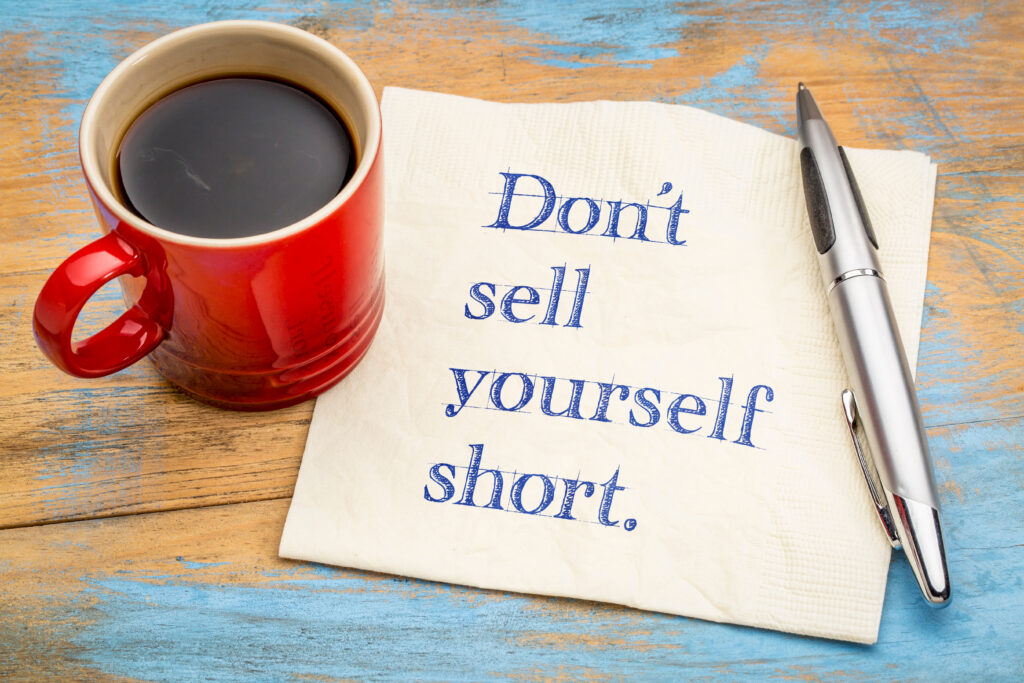
Don’t Sell Yourself Short!

It’s 2021, and it’s a new year. And I hate even to be cliche, but it may be time for a new you. Today I’m going to talk to you about why you can’t sell yourself short as a producer.

Take Control of the Phone

It’s a new year, and I hate to use the cliche, but it may be time for a new you. Let’s talk about three things that producers do to sell themselves short. The first one is they don’t take control of the phone call. How many times have you heard this? “Hey, Mr. Prospect, this is David at Florida Risk Partners. Listen, I know you weren’t expecting my call today, so I promise I’ll keep it brief.” Hey, I’m an upbeat, fun, friendly guy. You’d want to talk to me for a few more seconds. The problem is I’m weak. I’ve sold myself short. I haven’t put a value on my own time to let that person know I’m investing in them as much as they’re investing in me. Flip the script a little bit. Maybe try something like this. “Hey, Ms. Prospect, this is David at Florida Risk Partners. I know you weren’t expecting my call, and I promise to be brief. And quite frankly, I’ve only got about a minute myself. So, I promise we’re going to get through this.” Now they understand that my time is just as valuable as theirs.

Take Control of the Meeting

What about a new business meeting? How many times as a producer, have you gone into a new business meeting, and you just get grilled right out of the box with tons and tons of questions? Why not step back, take a deep breath, and let that prospect know this is an interview that goes two ways? “Listen, I understand all your questions. And honestly, I want to make sure we’re on the same page. I’m here today because I need to make sure that you and your company will be a good fit for my firm just as much as you need to decide the same. So, as long as we understand each other, I’m happy to continue going on, but I just wanted to make sure this isn’t a shoo-in. I still have decisions that need to be made on my side of the table as well.”

Now, you may irritate some people. But guess what? You’re going to gain respect from a lot more. People appreciate when you come from a position of power, control, and one where you’re on a level playing field. Now, there are people out there that like to beat up on the weak. They’re not my clients anyhow. Don’t undervalue your time.

Take Control of the Process

The biggest area where I see producers sell themselves short is they compete on price. They quote business. Instead of solving problems with a value proposition, they sell products for a price. What happens when the market hardens? What happens when you can’t get that coverage from that carrier anymore? What happens when pricing goes up? What happens when somebody else comes in and saves them 50 bucks a year? If you sell on price, you die on price, period. Value propositions, if written correctly, are recession-proof. They’re market hardening-proof. When the market hardens, my value proposition gets much stronger because companies are looking to save money. They’re looking to decrease turnover. They’re looking to train their people correctly. There are so many different things that I can discuss. Whether we go in with a learning management system through ThinkHR, or we’re proactively doing experience modification factors and auditing them with Modgic, it’s all about the value with Florida Risk.

We tell our prospects that if they want to hire us, they can hire us, but we have to place all of the insurance because that is the funding mechanism to buy our value proposition. You can’t get all of this unless we can do this. Because you’re already paying money to somebody, you’re just not getting what we’ve talked to you about today. And by focusing on the value we bring, we focus internally, and we allow them to see externally what we can do for them. But you enter that meeting with a position of confidence. You can confidently talk about all the times your value proposition has made an impact on a prospect who became your client. It’s challenging to talk about the endless number of times that you’ve saved a ridiculous amount of money for somebody.

Which one do you think resonates more? The fact that you saved somebody $10,000 in premium or the fact that Florida Risk went in and saved somebody $75,000 due to an error in a mod or by cleaning up reserves on claims, or even by identifying and putting measures in place to control the soft costs associated with their claims. I can assure you the value proposition plays better and longer.

So, as we go into ’21, this is my challenge for you. Don’t sell yourself short. Look at these three things: the phones, the meeting, and selling on value. Change up what you’re doing. Go in with a position of strength. You’re going to kill it in commercial insurance.

Producers

Parametric Insurance Explained: How Middle Market Producers Can Hedge Economic Loss, Protect Revenue, and Differentiate at the Point of Sale

The commercial insurance industry is in the middle of a quiet evolution.

While most conversations still revolve around premiums, deductibles, limits, and carrier appetite, a different category of risk transfer has been gaining traction beneath the surface—parametric insurance. It is not new, but it is finally becoming accessible, relevant, and actionable for middle market producers who are willing to think differently about risk.

In a recent episode of the Power Producers Podcast, I sat down with Brian Thompson from Descartes Underwriting to unpack what parametric insurance actually is, what it is not, and why producers who ignore it may be leaving their clients—and themselves—exposed.

This article breaks that conversation down into practical, producer-friendly language and shows how parametric insurance fits into modern middle market risk management.

Read More »

From Bottleneck to Builder: Why Systems, Culture, and Accountability Define Real Business Growth

For most entrepreneurs, the decision to start a business is rooted in the promise of freedom. Freedom from a boss, freedom to control income, and freedom to build something meaningful. Yet for many business owners, particularly in service-based industries and middle-market companies, that freedom slowly erodes. What begins as ownership eventually turns into obligation, where the business demands constant attention and the owner becomes the single point of failure.

Read More »
Cyber

Why Standalone Cyber Insurance Beats BOP Extensions Every Time: Protecting Clients from Modern Threats

The insurance industry is full of shortcuts. Some producers look for ways to streamline the quoting process, others avoid hard conversations with clients, and many rely on endorsements or extensions because they are “easier” than diving into the details. Nowhere is this more dangerous than in the world of cyber insurance.
Too many agents assume that a cyber endorsement on a BOP or commercial package policy is “good enough.” It isn’t. In fact, treating a BOP cyber extension as a replacement for a standalone cyber policy leaves clients dangerously exposed, puts producers at risk of losing accounts, and opens the door to costly errors and omissions (E&O) claims.
Cyber threats evolve faster than any other area of risk, and endorsements simply can’t keep up. If producers want to protect their clients and themselves, it’s time to understand why standalone cyber insurance is non-negotiable.

Read More »

Cyber Insurance Risk Management: Why MFA, MDR, and BYOD Policies Can’t Wait for a Hard Market

The cyber insurance market has softened in recent years. Requirements that were once rigid — like mandatory multi-factor authentication (MFA) or endpoint detection and response (EDR) tools — have been relaxed by many carriers. But here’s the danger: just because carriers aren’t demanding these safeguards today doesn’t mean businesses can afford to ignore them.

Read More »

Responses

Test Message

Killing Commercial Login