
Insurance Sales Strategies: Inside Sales, AI, and the Human Skills Middle Market Producers Can’t Ignore
More information does not automatically create a better sales conversation.
A producer can research a company, review its website, and arrive with pages of AI-generated notes. Yet the opportunity can still fall apart if those details become assumptions instead of better questions.
Effective insurance sales strategies depend on what happens next: how the producer listens, validates information, and connects the conversation to the buyer’s actual concerns.
In a recent episode of the Power Producers Podcast, David Carothers sat down with Lynn Hidy, founder of UpYourTeleSales and author of Mastering Inside Sales Leadership, to explore that connection.
Their discussion covered inside sales, agency culture, virtual meetings, and practical applications of AI. Throughout the conversation, one theme remained consistent.
Better tools create opportunities. Salespeople still need the skills to turn those opportunities into useful conversations.
For middle market producers and agency owners, the episode offers a practical look at how preparation, leadership, and technology can work together.
The Buying Process Has Changed. Buyers Still Need Confidence.
Lynn began her sales career answering inbound calls generated by mailed catalogs.
Customers saw a product, picked up the phone, and relied on the person answering to help them make a decision. The available information was limited, so the conversation carried considerable weight.
Today, buyers can arrive with product research, online comparisons, and answers generated by AI.
However, access to information does not mean they know how to apply it to their situation.
David illustrated this point with an example from his early experience selling athletic shoes. A customer might request a particular shoe, but a useful recommendation required understanding how that person planned to use it.
Simply fulfilling the request could miss the underlying need.
The same principle applies to commercial insurance.
A prospect may ask for a quote or describe a specific concern. Before recommending a direction, the producer needs to understand what prompted the request and what the buyer expects to accomplish.
Information becomes valuable when someone connects it to the customer’s circumstances.
That is where discovery earns its place in the sales process.
Better Insurance Sales Strategies Start with Better Questions
Lynn identified two questions that can improve the beginning of a conversation:
“What made you call us today?”
“What do you already know?”
The first question helps uncover the reason behind the contact. The second gives the salesperson a starting point for the discussion.
Together, they can prevent a familiar problem: delivering an explanation before understanding what the buyer needs explained.
For an insurance producer, the practical application is straightforward.
A prospect who requests a quote may be reacting to a renewal increase, a service frustration, or a change in the business. Those possibilities call for different follow-up questions.
These are examples of how producers can apply Lynn’s approach. The answer must come from the prospect.
Similarly, asking what the buyer already knows can reveal both useful knowledge and misunderstandings. As a result, the producer can tailor the discussion without repeating information or skipping an important concern.
Curiosity makes the conversation more relevant.
A prepared presentation has limited value if it answers questions the buyer never asked while overlooking the issue that brought them to the meeting.
Research Should Improve Your Questions
David raised a concern about the amount of information available to producers.
Research can be useful. It can also create misplaced confidence when someone assumes every detail is accurate, current, and relevant to the person they are meeting.
Lynn summarized the purpose of preparation clearly:
“Salesperson research is to make a better question.”
That distinction should shape how producers use online information and AI-generated summaries.
Suppose research suggests that a company has expanded into a new market. The producer can use that as a reason to ask about growth plans and operational changes.
The conversation should still establish whether the information is correct and what it means to the business.
Otherwise, the producer risks building a recommendation around something the prospect has never confirmed.
David also pointed out that information can be accurate and still be irrelevant. Knowing a personal detail about a decision-maker does not automatically make it appropriate for the sales conversation.
Research should help you understand the buyer’s business and ask informed questions.
Before using a detail, consider what it helps you discover. If it adds little to the discussion, it may not belong in the meeting.
Inside and Outside Sales Require Different Approaches
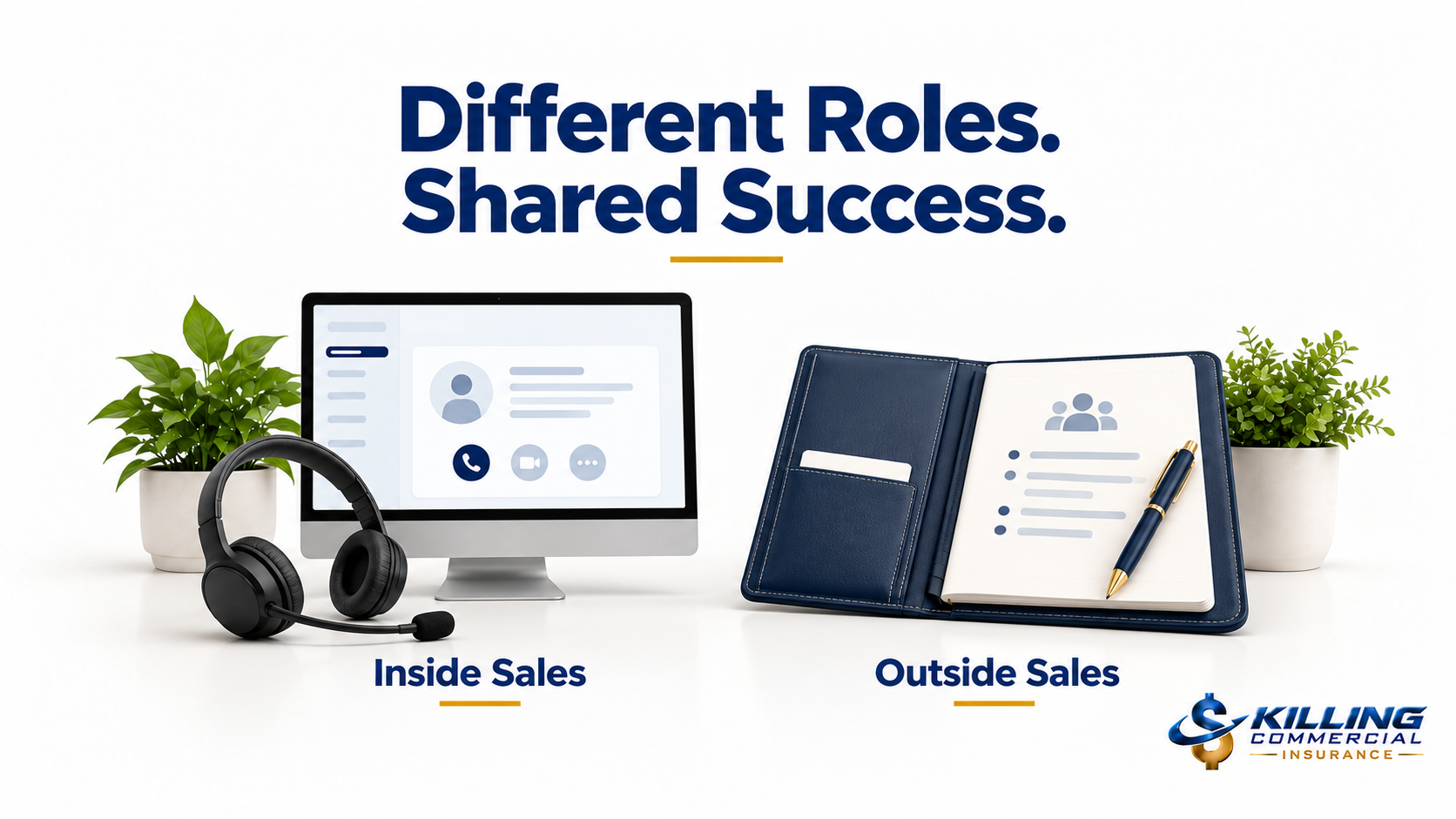
Lynn defined inside sales around communication through phone, video, email, and chat. Outside sales, by comparison, typically involves physically visiting prospects and clients.
Importantly, inside sales can include both inbound and outbound activity.
The distinction concerns how the work happens, rather than simply who initiates contact.
Lynn described a career built around relatively short conversations. An inside salesperson may need to establish relevance, understand the request, and determine a next step within minutes.
An outside producer may have a longer scheduled meeting or an opportunity to walk through a business.
Both roles require skill. However, the pace and demands can differ significantly.
For an agency owner, that means training should reflect the actual job.
An employee handling inbound opportunities needs to become effective at quickly understanding why someone called. Meanwhile, a producer pursuing a complex middle market account may need to manage a longer discovery and decision process.
The skills overlap, but the working conditions are different.
Treating every salesperson as though they face the same day can make coaching less useful.
Let Prospects Choose How They Meet You
David explained that virtual meetings have changed how his agency approaches initial conversations.
A short video meeting can help both parties determine whether a deeper discussion makes sense. It can also reduce the travel and scheduling demands associated with an in-person appointment.
Nevertheless, efficiency was only part of his point.
The prospect should have a choice.
Some buyers prefer an in-person conversation. Others appreciate the convenience of meeting virtually, particularly before deciding whether to move forward.
David’s approach is to ask how they would prefer to engage.
Lynn reinforced this idea with a story about a customer who valued the flexibility of working with her remotely. If he needed a detailed conversation, she could provide one. When his needs were simple, the interaction could be brief.
A useful sales process respects the buyer’s time and preferred way of communicating.
For producers, this creates an opportunity to make the first step easier. The objective is to establish whether there is a reason to continue, using a format that supports that conversation.
Leave Time to Complete the Work After the Meeting
Virtual meetings can make a calendar more efficient. They can also fill it so tightly that nothing happens between appointments.
Lynn described the problem with back-to-back scheduling: there is little room to capture decisions, identify next steps, or send a follow-up.
David shared a practical adjustment from his own process. He uses scheduling technology to maintain a 15-minute buffer between meetings.
That space supports the work surrounding the conversation.
For producers, the implication is worth considering. A productive meeting creates responsibilities. Someone needs to document what happened, confirm commitments, and move the opportunity forward.
If the calendar leaves no time for those activities, follow-through becomes harder.
Lynn also discussed allowing enough meeting time to avoid rushing the closing portion of a conversation. Finishing early can be preferable to losing attention while trying to squeeze in the next steps.
The broader lesson is to design the calendar around the full sales process.
Recognize Inside Sales for Its Actual Contribution
When David asked about common leadership mistakes, Lynn identified two.
First, organizations sometimes treat inside salespeople as though they should operate exactly like outside salespeople. Second, they treat the inside role as less valuable.
Smaller transactions can make that second mistake easy to overlook.
A large commercial account attracts attention. Meanwhile, a steady stream of smaller wins may contribute substantial revenue without receiving the same recognition.
Lynn described generating a million dollars in profit margin for a former organization through transactions averaging only a few hundred dollars in margin.
Her example challenged the habit of judging a salesperson primarily by the size of an individual deal.
Appointment-setting roles deserve similar consideration. When an employee consistently creates qualified opportunities, that work contributes to what the outside producer can accomplish.
The largest announcement in the sales meeting may not represent the team’s entire contribution.
Agency leaders need to understand what each role produces over time and recognize success accordingly.
Celebrate Different Roles in the Same Room
Lynn recommended recognizing inside and outside sales achievements in the same meetings.
That does not require identical goals. Instead, it requires making each role’s success visible.
An appointment setter who exceeds an agreed target should receive recognition for that result. An inside salesperson who consistently handles and closes appropriate opportunities should see that contribution acknowledged.
David described using automated deal notifications at his agency to share wins across the organization.
The leadership principle matters more than the notification itself.
What gets celebrated tells employees what the organization values.
If every announcement centers on the largest account, the rest of the team may reasonably conclude that their work carries less importance.
Lynn also cautioned against automatically moving a successful inside salesperson into outside sales. Strong performance in one role does not establish that another role fits the person’s skills or preferences.
Career development should account for that difference.
A move can make sense, but it deserves a deliberate conversation about the work involved and the support required.
Use AI to Strengthen Preparation and Coaching
The discussion eventually turned to AI and its role in sales.
Lynn encouraged salespeople to learn the tools their organizations provide. David added an equally practical requirement: actually use them.
Knowing that a feature exists does little for performance if it never becomes part of the process.
During the episode, David described using CRM-generated summaries to review previous interactions before a call. That gave him a faster way to understand the context surrounding the conversation.
He also discussed using AI-assisted call analysis to support coaching.
A review might highlight a missed follow-up question or a moment worth discussing with the salesperson. Those observations can give a leader a starting point for closer examination.
However, the output still needs review.
Lynn emphasized asking the team whether the information is accurate and useful. A tool’s presence in the organization does not prove that it improves the work.
Evaluate AI by whether it helps salespeople prepare, learn, and follow through more effectively.
That creates a clearer standard than adoption for its own sake.
Turn Customer Data into Focused Follow-Up
Lynn shared an example of an organization using an AI agent to review customer activity.
The system looked for patterns such as valuable customers who had stopped buying, accounts with limited recent communication, and quotes that had not resulted in orders.
Its purpose was to help salespeople decide where to focus their attention.
Those examples came from the organization she described. Insurance agencies would need to adapt the approach to their own relationships and sales cycles.
For instance, a producer might review opportunities with repeated proposals but no clear next step. An agency could also examine important relationships where expected follow-up has stalled.
These are practical applications of the discussion, rather than results reported in the episode.
The objective is to turn available information into a useful prompt for action.
A flag should lead to investigation and a conversation. It should not become an unsupported conclusion about why a customer has gone quiet.

Prepare from the Buyer’s Perspective
One of the episode’s most useful exchanges concerned preparing for a meeting from both sides.
David described asking AI to help a commercial producer prepare for a conversation with a manufacturing CFO.
The initial request focused on potential business concerns and questions the producer could ask.
Then he reversed the perspective.
What would that CFO want to ask a prospective insurance agent? What would the buyer need to understand before selecting an advisor?
That second step changes the preparation.
Instead of thinking only about the questions they intend to deliver, producers can consider the questions they need to answer.
Lynn extended the exercise by suggesting that producers explore potential objections and concerns from the buyer’s point of view.
For example, what might make the prospect hesitate about working with the agency?
These exercises can help identify gaps in preparation. They cannot establish what a specific CFO actually thinks.
Use the output to develop hypotheses, strengthen your questions, and prepare relevant evidence. Then let the conversation confirm what matters.
The goal is to enter the meeting ready to listen and respond thoughtfully.
Build Insurance Sales Strategies Around Better Conversations
David and Lynn’s discussion connected technology, leadership, and sales fundamentals.
Research should make discovery more informed. Virtual meetings should make engagement easier. Recognition should reflect the contributions of different roles.
Similarly, AI should help salespeople use information and improve their work.
None of those improvements removes the need to understand the person on the other side of the conversation.
Lynn repeatedly emphasized listening, curiosity, and emotional intelligence as skills worth developing alongside technology.
For middle market producers, that creates a practical direction.
Before your next appointment, review the information you have gathered and identify what still needs validation. Consider how the buyer may evaluate you. During the meeting, leave room for answers that change your assumptions.
For agency owners, examine whether your team has the tools, coaching, and recognition to do that work consistently.
Start with one change: turn a research finding into a better question, recognize an overlooked contribution, or use an available tool to improve your preparation. Then judge the improvement by the quality of the conversation it helps create.

Building a Data-Driven Insurance Agency: Premium Is for Show, Revenue Is the Dough
An agency can write more premium and still struggle to understand whether the business is becoming more profitable. Premium volume tells part of the story.

Insurance Intake Automation: How Better Data Creates Better Client Conversations
A prospect agrees to talk about insurance. Then the work begins: locating declarations pages, answering questions, sending documents, and repeating information that already exists somewhere

Value-Based Selling in Insurance: How Guffy Wright Creates Client Alignment
Guffy Wright thought he had presented an offer that would be difficult to refuse. His insurance proposal was approximately $2 million less expensive, and he

Leadership Skills for Insurance Producers: Building Confidence, Making Better Decisions, and Understanding People
Sitting in a prospect’s parking lot, David Carothers started questioning whether he belonged inside the building. The company was a significant opportunity. Its operations were
Commercial Insurance Prospecting: How Better Data Creates Better Producers
A renewal date tells you when to call a business. It does not necessarily tell you why the owner should take the call. That difference

Relationship Building in Sales: The Human Advantage in the Age of AI
A baseball card tucked inside a thank-you note would be easy to overlook. For Patrick Galvin, it became a reason to return to a mortgage
Responses