
AI for Insurance Agencies: Better Workflows, Stronger Relationships, and Practical Results with Caleb Cramer

An agency can add technology and still leave its people buried in administrative work.
Applications need information. Submissions require documents. Email threads contain details that someone must find, organize, and move into the next step.
Meanwhile, clients expect timely answers and useful conversations.
The opportunity behind AI for insurance agencies is to reduce that repetitive work so producers and account managers have more capacity for the relationships that drive the business.
In a recent episode of the Power Producers Podcast, David Carothers sat down with Caleb Cramer of 1Fort to discuss that opportunity. Their conversation explored email-driven workflows, submission preparation, employee adoption, and the economics of building technology yourself.
Throughout the episode, they returned to a practical standard.
Technology should improve the work your agency completes and the experience your clients receive.
For agency owners and middle market producers, that means looking beyond an impressive demonstration and asking what changes in the actual workday.
Start with the Agency Problem You Need to Solve
David opened the discussion with a concern about the speed of AI adoption.
Tools have made it easier to create something that looks useful. However, producing an initial result is different from building a dependable system that an agency can operate around.
He described experimenting with a simple tool that could turn an excess and surplus lines quote into a proposal.
The experiment showed what was possible. It also raised another question: How much time would it take to make the output consistently usable?
For David, that calculation matters more than the excitement of creating the first version.
An agency owner has responsibilities that compete for the same hours. Development, testing, maintenance, and future changes all belong in the decision.
Caleb reinforced the point by questioning whether enthusiasm for AI translates into results at the agency level.
Before evaluating a tool, identify the problem clearly.
Is the team repeating data entry? Are submissions delayed by missing documents? Does important account information remain scattered across email?
A defined problem gives the technology a useful job.
Consider the Full Cost of Building It Yourself
David’s position was grounded in how he allocates his time.
Even when he can create a basic solution, building and maintaining it may offer less value than working with someone whose primary responsibility is technology.
Caleb added that AI increases the capabilities of experienced developers as well as beginners.
Access to the same tools does not erase the difference in experience.
David connected this to how he approaches specialized resources for clients. He described using an outside loss control professional with direct experience in a prospect’s industry.
That expertise helped him present a more relevant solution.
The same reasoning applies inside an agency.
Owners can identify needs, evaluate specialists, and assemble useful resources without personally becoming experts in every discipline.
The ability to build something is one part of the decision. The business value of doing it yourself is another.
For producers, this is also a reminder to protect the time spent developing opportunities and advising clients.
A technology project should earn its place alongside those responsibilities.
Why Small Commercial Workflows Deserve Attention
Caleb described small commercial as a central focus of the work discussed in the episode.
These accounts can require substantial administrative effort even when the revenue available to support that effort is limited.
Someone still needs to gather information, complete forms, select markets, and manage follow-up.
The challenge is familiar to agencies serving multiple account sizes.
A smaller account can move through many of the same operational steps as a larger one. When those steps depend heavily on manual work, the time commitment becomes difficult to manage.
Caleb outlined an approach that begins earlier in the process, using information already arriving through email.
His objective was to help account teams return to work that had already progressed toward a review point.
That distinction matters.
A system that identifies another task may help organize the day. A system that prepares part of the work can reduce what the team must complete.
For agency owners, the question becomes specific: Which recurring steps could move forward before an employee begins working on the account?
AI for Insurance Agencies Can Start in the Inbox
Email was one of the most practical subjects in the conversation.
Caleb described connections with Outlook and Gmail that allow the system to use account information contained in messages and attachments.
In his explanation, that context could include a prior policy, a declarations page, or the people involved in handling the account.
The purpose was to recognize relevant information and begin defined workflow steps.
David immediately connected this to the difficulty of managing his own inbox.
He shared an example involving equipment invoices sent by a prospect. An existing email rule moved those messages into an invoices folder.
The rule operated as configured, but David did not realize the information he needed had been routed there.
That story illustrates why organizing messages and advancing account work are different challenges.
Caleb clarified that the approach he described focused on reading and reacting to account-related context. General inbox cleanup was a separate issue.
For agencies evaluating similar tools, that distinction belongs in the demonstration.
Ask what happens after the system identifies a useful document. The answer should explain how the account moves forward.
A Submission Checklist Makes the Work Easier to Manage
Caleb walked through an example of preparing a submission.
The system reviews the available information and identifies what the account still requires. If loss runs are missing, the team receives a focused request for that item.
Instead of starting with an entire list of unfinished tasks, the employee can concentrate on the remaining gaps.
David emphasized that agencies need this kind of checklist even without AI.
A repeatable process establishes what a complete submission should contain. It also makes missing information easier to recognize.
For commercial producers, the practical application is straightforward.
Document the information required for the types of accounts you pursue. Clarify which items are consistently necessary and which depend on the risk or market.
Then examine where the team repeatedly spends time collecting or entering that information.
Automation becomes easier to evaluate when the underlying process is clear.
Without that foundation, a faster workflow can still produce incomplete submissions and unnecessary follow-up.
Prepare the Work and Preserve the Review
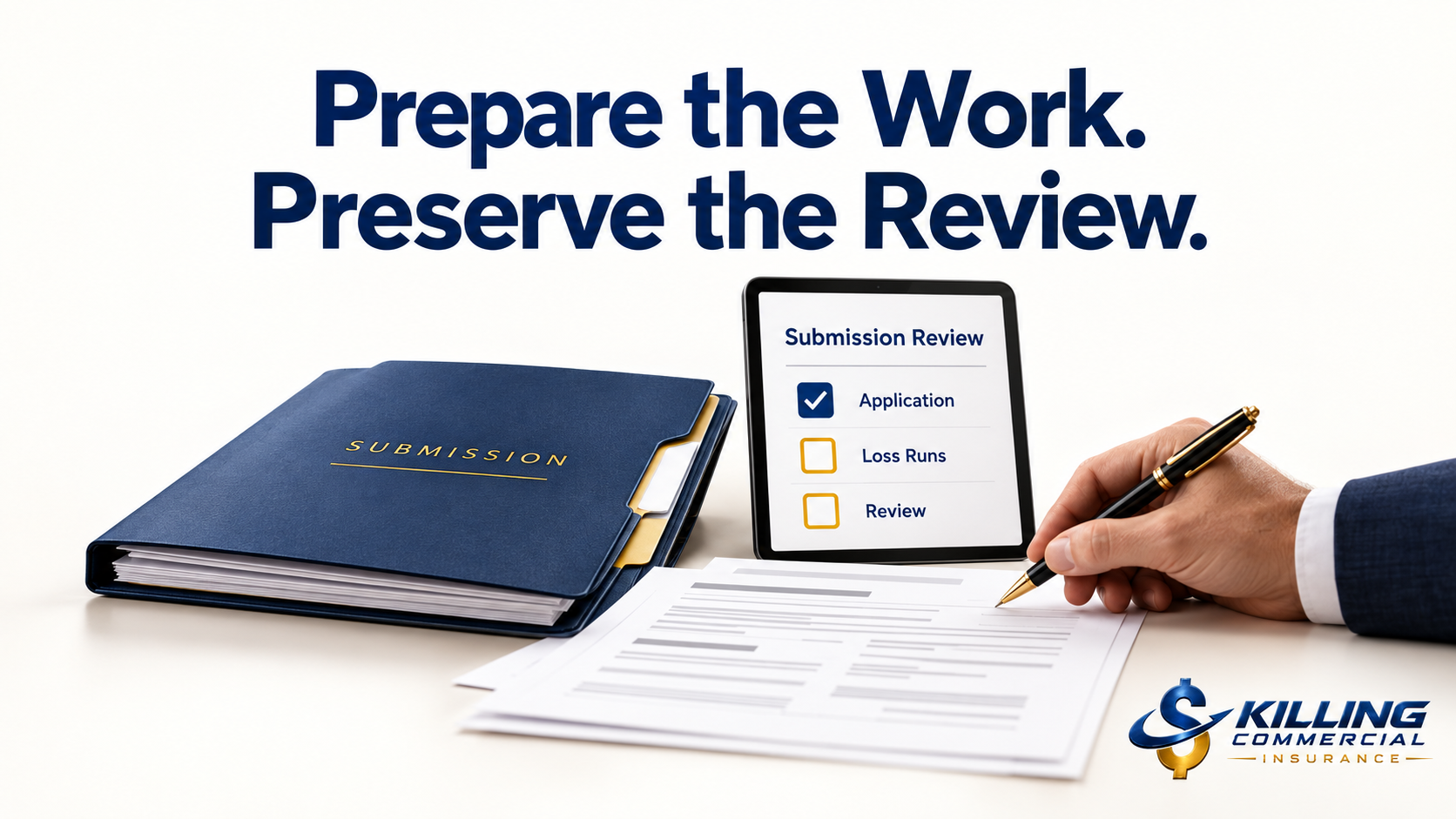
During the episode, Caleb described using available account information to populate ACORD forms and, where applicable, supplemental applications.
He also discussed preparing draft messages for wholesaler or MGA contacts identified through prior correspondence.
The intent was to complete much of the routine preparation while leaving a person involved at a defined review point.
For example, an account team could review proposed markets and add another option based on a recent appetite change.
That is a meaningful part of the workflow.
The system can help organize information and prepare documents. The team still needs to confirm that the work fits the account and the intended placement strategy.
Caleb characterized the approach as getting the work largely prepared so the employee can review and refine it.
That description should not be treated as a guaranteed percentage of time saved. Its value is the operating model.
Move repetitive preparation forward, make unresolved items visible, and give the responsible person a clear opportunity to assess the result.
Keep Professional Judgment in the Process
Caleb drew a distinction between repetitive execution and judgment.
The work he emphasized involved recurring steps that account teams must complete. His focus was on helping those tasks progress while preserving human involvement.
For producers and account managers, that creates a useful way to evaluate automation.
Consider the difference between locating a document and deciding whether its contents adequately explain a risk.
Similarly, preparing a form is different from determining whether the proposed coverage addresses the client’s circumstances.
Those activities can be connected without being treated as interchangeable.
David’s broader concern was that agency owners could become so distracted by technology that they lose focus on clients.
The remedy is to define where automation ends and professional review begins.
A useful workflow makes responsibility clearer while reducing repetitive effort.
That includes identifying who reviews the output, how missing information is handled, and what needs to happen before the next step proceeds.
Let Account Managers Identify the Friction
The conversation then moved from software capabilities to employee adoption.
David compared some of the concerns about AI with the resistance agencies experienced when introducing virtual assistants.
Employees may worry that new technology will replace them. Leadership can make that uncertainty worse by evaluating tools privately and announcing decisions without explaining their purpose.
David recommended beginning with a direct conversation.
Ask account managers to identify the tasks they dislike most or find most repetitive.
Those answers can reveal practical opportunities for support. They also allow employees to participate in shaping the change.
The discussion should then connect the proposed workflow to what the team will gain.
Will account managers have more time for renewal conversations? Can they respond to clients sooner? Which tasks will still require their expertise?
Specific answers are more useful than broad assurances about efficiency.
For agency owners, implementation begins with understanding the work from the employee’s perspective.

Measure the Value of Client Conversations
David shared a coaching example involving an account manager who spent significant time on the phone with clients.
The agency owner initially viewed those conversations as a reason other tasks were falling behind.
David asked whether the owner had measured what the calls produced.
According to his account, the employee was growing relationships through cross-selling and account rounding at renewal.
The conversations were creating business value.
Rather than reducing that activity, the agency added support for the administrative work competing with it.
The lesson is relevant to AI adoption.
A full task list does not reveal which activities contribute most to the agency’s results. Leaders need to understand the outcome of the work before deciding what to change.
An account manager who builds trust and identifies additional needs may be especially valuable when repetitive preparation is removed from the role.
Use the capacity you recover to support the work that clients recognize and the agency benefits from.
That requires measuring more than how quickly someone clears a queue.
Relationships Also Depend on Reliable Execution
David and Caleb applied the same reasoning to wholesale relationships.
David explained that personal connections influence where producers place business. However, delays and repeated follow-up can undermine an otherwise strong relationship.
He described the familiar cycle of assembling documents, sending a submission, answering questions, and waiting for quotes as renewal approaches.
His concern centered on that workflow.
For producers, a responsive process affects their ability to serve the insured. For wholesalers, it influences the experience of the retail agent.
Caleb reinforced the idea that a business relationship includes delivering reliably for the other party.
Knowing someone personally matters. Helping that person meet commitments matters too.
The discussion also included possibilities for faster, more connected placement workflows. Those ideas were forward-looking, rather than a promise that every account could move immediately from intake to a bindable quote.
The practical takeaway remains useful today: Review the handoffs that repeatedly slow work down.
Better execution can strengthen the relationships already in place.
Judge Software by Outcomes, Not Time Spent Using It
Caleb challenged the idea that more time inside a platform proves its value.
For the workflows he described, the goal was to accomplish more with less interaction required from the agency.
That changes the evaluation.
A busy dashboard or a long list of features says little about whether the team completes work more effectively.
Instead, agency owners can establish measures tied to the original problem:
Time required to prepare a submission.
Frequency of missing-information follow-up.
Manual steps completed by account teams.
Timing of renewal preparation.
Capacity available for client conversations.
These are practical ways to apply the episode’s discussion, rather than performance results reported in it.
David also warned against blaming software that was never properly implemented.
Purchasing a subscription does not establish a workflow. Employees need onboarding, clear expectations, and a reason to use the system consistently.
Caleb described accountability on both sides: The agency provides the agreed inputs, and the vendor delivers the outcomes it committed to support.
Build a Deliberate Approach to Agency Automation
The episode acknowledged two unhelpful patterns.
Some agencies resist change long after a need becomes clear. Others move between tools so frequently that their teams never develop a consistent process.
David encouraged finding a workable balance.
An agency can stay informed and test useful technology while remaining deliberate about implementation.
Start with one recurring problem. Involve the people who handle it. Define what a better outcome would look like and how you will assess it.
During evaluation, ask the provider to walk through your actual workflow, including incomplete information and the points where staff must review the work.
Then give the selected approach enough structure to be evaluated fairly.
AI for insurance agencies becomes valuable when it supports dependable execution and creates capacity for meaningful client work.
The objective is a stronger agency, with people spending more of their day where their judgment and relationships matter.
Listen to “AI, Automation, and the Future of Agency Operations with Caleb Cramer” on the Power Producers Podcast for the full conversation. Explore Killing Commercial for more practical discussions about agency operations, producer development, and building a business around better client relationships.
Captive Insurance Strategy: Thinking Beyond the Renewal with Warren Cleveland
Winning an account should start a longer conversation about the client’s business. Too often, however, the relationship settles into a familiar routine. The producer places

Cyber Insurance Compliance: Better Applications, Stronger Risk Conversations, and the Role of Verification with Matt Naumoff
A completed cyber application tells you what a business says about its security. The next question is whether the evidence supports those answers. That distinction

AI for Insurance Agencies: Better Workflows, Stronger Relationships, and Practical Results with Caleb Cramer
An agency can add technology and still leave its people buried in administrative work. Applications need information. Submissions require documents. Email threads contain details that

Business Credit Card Points: Turning Everyday Expenses Into Better Travel with Justin Froeber
A large points balance does not automatically mean you have a strong rewards strategy. Business owners often know how many points they have accumulated. Fewer

Personal Branding for Insurance Agents: Building a Stronger Presence with Daniel Wakefield
Your reputation starts forming before a prospect meets you. A LinkedIn profile, a website photo, or an article can shape someone’s first impression of your

Commercial Insurance Prospecting: Lowering Resistance, Asking Better Questions, and Using AI with Josh Braun
A full calendar can hide a poorly qualified pipeline. Producers spend weeks chasing prospects, preparing presentations, and following up on conversations that never had a
Responses