
Commercial Insurance Prospecting: How Better Data Creates Better Producers

A renewal date tells you when to call a business. It does not necessarily tell you why the owner should take the call.
That difference sits at the center of effective commercial insurance prospecting. Producers need enough information to identify an opportunity, explain why it deserves attention, and start a conversation that goes beyond asking for a chance to quote.
In an episode of the Power Producers Podcast, David Carothers sat down with Rob Gifford, co-founder of Insurance Xdate, to explore how better data and AI can support that work. Their discussion covered workers’ compensation prospecting, carrier filings, appointment preparation, agency workflows, and the habits that help producers build lasting books of business.
The technology examples were compelling, but the conversation kept returning to execution. A database can make research easier. An AI tool can organize information. Neither creates a client relationship until a producer uses the information to ask better questions and follow through.
For insurance producers and agency owners, the episode offers a practical way to think about prospecting: find a relevant reason to call, prepare for the next step, and keep building opportunities before you urgently need them.
Watch the full Power Producers conversation with Rob Gifford.
Commercial Insurance Prospecting Needs More Than a List of Renewal Dates
Rob’s interest in prospecting data came from his own experience as a producer.
Early in his career, knowing that a business had an upcoming insurance renewal did not resolve his biggest concern. He still needed something useful to say when someone answered the phone.
That is a familiar challenge for newer producers. You can have a list of businesses, contact information, and time blocked for calls, yet still hesitate because your opening sounds like every other agent’s.
A renewal date provides timing. Information about the business and its insurance situation helps establish relevance.
During the conversation, Rob explained how access to carrier pricing information gave him a more concrete starting point. Instead of relying entirely on a general introduction, he could approach the business with a subject worth exploring.
David emphasized the same principle throughout the episode. Preparation should help you explain why you are calling this particular business.
That might involve a carrier filing, an experience modification factor, a change in the company’s operations, or another detail that raises a worthwhile question. The objective is to identify something you can discuss honestly and investigate further.
A useful prospecting list therefore does more than tell you who exists. It helps you decide which businesses fit your approach and what might make a conversation valuable to them.
Turn Prospecting Data into a Reason to Talk
Insurance Xdate’s role in the discussion extended beyond providing policy expiration information.
Rob described a platform that brings together insurance and business data so producers can identify opportunities and prepare more efficiently. The conversation included workers’ compensation records, Department of Transportation information, nonprofit filings, and carrier filing analysis.
Each source can contribute something different.
Workers’ compensation information can help frame questions about an account’s current program. Transportation records can provide context for businesses with fleet exposures. Nonprofit filings can support research into an organization’s activities and financial picture.
The important step is connecting the information to a relevant conversation.
A producer does not create value simply by reciting facts from a database. The facts need to support a question, a concern, or a reason to review the account.
For example, information suggesting that a business has expanded could lead to questions about how its operations and insurance needs have changed. A carrier filing could provide a reason to discuss the next renewal. An experience modification factor could support a conversation about claims and risk management.
These are starting points for discovery. The producer still needs to understand the current situation.
David’s broader message was that useful preparation changes how you enter the conversation. You have something specific to explore, and the prospect has a clearer reason to listen.
Research in Stages So Preparation Leads to Action
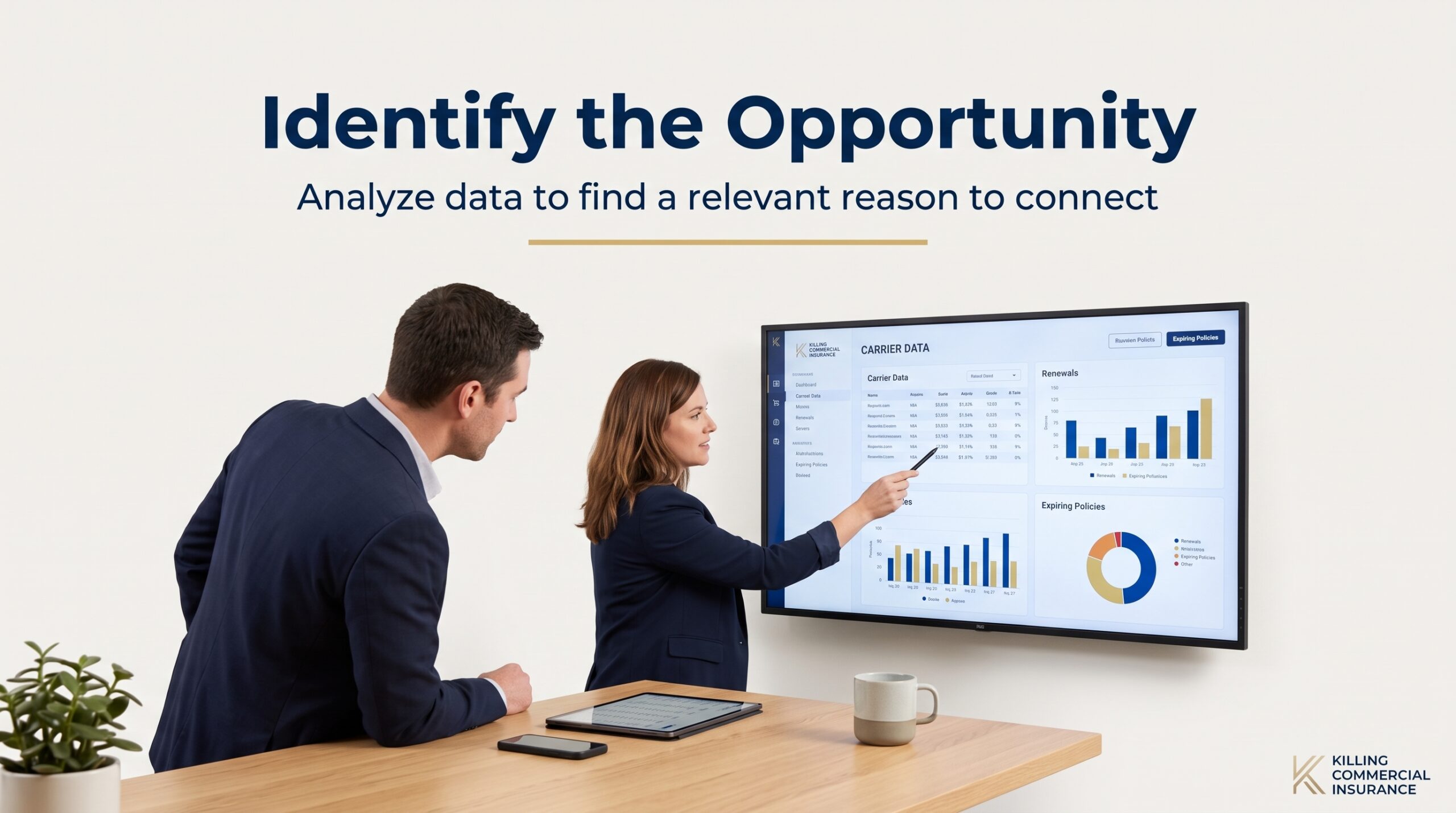
David recalled the amount of manual work involved when he first began building his pipeline.
He moved between websites, gathered information, and kept extensive notes. The research took months. Looking back, he acknowledged that he spent too long preparing before moving forward.
His recommendation for producers today is to divide research into stages.
First, gather enough information to earn the appointment. Once the appointment is scheduled, do the deeper work needed to make that meeting worthwhile.
That distinction matters because research can become a comfortable place to hide.
You can spend hours collecting information about a company and feel productive without ever contacting someone who could become a client. The activity looks professional, but the opportunity has not moved.
Prepare for the decision directly in front of you
Before an initial call, you need a relevant reason to reach out and enough understanding to avoid a generic approach.
Before a discovery meeting, you need more context about the business, its operations, and the questions you want to explore.
Before making a recommendation, you need the information required to support it.
Those stages call for different levels of preparation.
A database can shorten the research process, but producers still need to decide when they have enough information to act. Otherwise, faster access simply creates the opportunity to spend more time researching.
The practical question is whether the next piece of information will change what you do next. If it will not, it may be time to make the call.
Carrier Filings Can Help Producers Spot a Timely Conversation
One of the episode’s central examples involved carrier filings.
Rob described how Insurance Xdate was using AI to process filings and organize the information through its xRate database. During a screen share, he showed a view that condensed lengthy documents into information an agent could review more quickly.
The discussion included proposed or filed changes, affected policyholders, and the premium associated with those filings.
For a producer, the value is the ability to locate a development that may matter to a prospect without manually reading every page first.
That does not eliminate the need to understand the filing. It gives the producer a more efficient route to the relevant material.
A filing also needs context. You still need to consider its effective date, scope, applicable business, and relationship to the prospect’s actual policy.
The strongest use of this information is to open an informed discussion.
You can explain that you have identified a development worth reviewing and ask how the business is preparing for renewal. That is more useful than making a broad prediction about what the client will pay.
Rob’s example demonstrates how AI can help organize difficult source material. David’s reaction highlights why that matters in sales: less time navigating documents can mean more time preparing a relevant message.
Connect AI to the Data That Gives It Context
Rob also discussed Insurance Xdate’s use of Model Context Protocol, or MCP, to connect AI tools with its platform.
His example was practical. A producer could ask an assistant to identify prospects near existing appointments, review relevant carrier information, and help prepare materials for nearby visits.
David immediately focused on the sales implications.
If you already have an appointment in an area, better preparation can help you make more deliberate use of that trip. You can identify nearby businesses that fit your approach and arrive with a reason to introduce yourself.
Those additional visits are opportunities to start conversations. They still require the producer to earn someone’s attention and move toward an appointment.
Start with a useful business task
The most helpful AI request begins with a clear objective.
In Rob’s example, that objective was to make an existing day of appointments more productive. The assistant needed relevant account information and criteria that reflected the producer’s goals.
A producer applying that idea might ask for nearby businesses that fit a chosen industry, size, or renewal window, then review the results before deciding where to visit.
The information should support an appropriate introduction or follow-up. It should give the producer something worth discussing.
For current details about the platform’s tools and integrations, explore Insurance Xdate’s prospecting features.
Evaluate Technology Against the Value of Your Time
David challenged the idea that producers should recreate every research process themselves simply because general-purpose AI tools are available.
His argument centered on time.
A producer may be capable of finding information, extracting it, organizing it, and building a workflow. That does not automatically make doing all of those tasks the best use of the producer’s day.
Specialized providers have already invested in collecting and structuring data. Using that work can reduce the time between identifying a prospect and taking action.
David suggested that producers think about the hourly value of their work and compare it with how they actually spend their time.
That creates a useful question for evaluating any subscription: what work will this tool remove, and what will I do with the time it returns?
The answer needs to be concrete.
Will you make more calls? Prepare more effectively for appointments? Follow up sooner? Spend more time discussing a client’s risks?
A tool can improve efficiency while the producer’s habits remain unchanged. If the saved time disappears into more administration or endless experimentation, the business may see little benefit.
The goal is to create more room for the activities that move an opportunity forward.
Workers’ Compensation Can Provide a Focused Entry Point
David described workers’ compensation as a useful lead line for producers because it can provide concrete information to discuss.
The episode explored experience modification factors, loss history, carrier placement, and loss cost multipliers. Those details can help a producer frame questions about how an account is being managed.
The discussion also included businesses that originally obtained workers’ compensation through a payroll provider.
David’s example concerned companies that chose that arrangement because it was convenient when they were starting out. As the business grew, its needs and insurance profile could change while the original arrangement continued.
His prospecting lesson was to look for situations worth reviewing.
A growing company may benefit from a conversation about whether its current placement still fits. The producer’s job is to investigate the account and understand the options available.
Ask whether the arrangement still serves the business
Convenience matters to business owners.
If payroll-linked administration makes their work easier, a producer needs to understand that benefit before proposing a different approach.
David described cases where his agency changed the workers’ compensation placement while helping the business retain a pay-as-you-go arrangement through separate administration.
His experience illustrates a broader discovery question: what does the client value about the current setup, and can a different approach preserve that value?
The answer depends on the particular business, carrier, provider, and program.
A thoughtful conversation looks at the whole arrangement. It considers coverage, administration, service, and the owner’s priorities alongside price.
That gives the producer a stronger foundation for a recommendation than assuming every account in a particular channel represents the same opportunity.
Use AI to Make Analysis Easier to Understand
David also described using AI to organize loss-run information and prepare client-facing reports.
In his workflow, the output helped show patterns in claim frequency and severity and identify areas that deserved risk management attention.
The appeal was the ability to make complex information easier to review.
An owner may not get much value from receiving a stack of loss runs without explanation. A well-organized analysis can help show which issues are recurring and where the business should ask more questions.
The producer’s contribution is the interpretation.
What appears to be driving the losses? Which patterns need further investigation? What should the client prioritize? How does that connect to the broader insurance program?
The report supports those conversations when its conclusions are grounded in the underlying records.
A polished document needs to be accurate and useful. Producers should review extracted information and recommendations before relying on them in a client meeting.
The episode’s larger point is that technology can make analytical work more accessible. The practical advantage comes from using that analysis to help the client understand a problem and decide what to do next.
Better Workflows Can Change Which Accounts an Agency Can Serve
The discussion moved beyond outbound prospecting into agency operations.
David explained how Florida Risk Partners was using Cara and HubSpot to support inbound inquiries, collect information, create records, compare quotes, and prepare proposals.
Those workflows helped the agency reconsider small commercial business that it had previously been reluctant to pursue.
Historically, the work involved in handling an account can make a smaller policy difficult to serve profitably. Information gathering, applications, quote comparisons, and proposal preparation all consume time.
David described reducing that burden through a connected process.
The result, in his account, was an opportunity to serve smaller businesses while building a broader foundation beneath the agency’s middle-market book.
Use the time saved to explain the recommendation
The proposal example was especially relevant.
David described presenting the options considered, identifying the recommended placement, and explaining the reasons for that recommendation.
That explanation is where the client can see the value of the producer’s judgment.
A quote comparison is useful when it helps the business understand meaningful differences. The producer still needs to review the documents, confirm the information, and explain how the recommendation fits the client’s circumstances.
For a related discussion of these workflows, explore the Power Producers episode on building an AI-powered insurance agency with Nikhil Kansal.
The prospecting connection is straightforward: a more efficient agency can create additional capacity for producers to develop business and advise clients.
Consistent Prospecting Matters More Than Occasional Intensity
When David asked what advice Rob would give a new producer using the platform, Rob’s answer centered on consistency.
Use it. Set aside time. Keep practicing.
That advice applies to both the software and the sales activity it supports.
A producer who uses a tool briefly and then leaves it untouched for weeks will have to regain familiarity. The same interruption can affect cold calling. Regular practice helps a producer become more comfortable with openings, questions, and objections.
Consistency also prevents prospecting from becoming an emergency response.
If you only begin building opportunities when revenue is under pressure, you are asking a process that takes time to produce an immediate result.
A steady routine creates more opportunities to learn about businesses and develop relationships before the next renewal.
The routine can be manageable. Choose a defined segment, prepare a relevant reason to call, complete the outreach, and record what you learn.
Then repeat.
The database makes the work easier to organize. The producer supplies the persistence.
Today’s Calls Can Become Next Year’s Opportunities
Rob made an important observation about the annual rhythm of commercial insurance: work completed this year can create opportunities in a later renewal cycle.
A call that does not produce an appointment can still provide useful information.
You might learn who makes the decision, when the business begins reviewing its program, or what it values about its current relationship. You may discover that your initial approach needs to change.
That information becomes valuable when you record it and use it later.
An unsuccessful first attempt should therefore lead to a better-informed next attempt.
David connected this to the need for a robust pipeline. Producers need enough opportunities that one pending account does not determine the outcome of the month.
That depth also supports better judgment.
When you are relying on one deal, it becomes harder to walk away from a poor fit or challenge an unproductive buying process. A healthier pipeline gives you more room to be patient and selective.
Keep prospecting through different market conditions
David also warned against pausing business development while concentrating exclusively on renewals.
In his view, changing market conditions affect how willing prospects are to consider a conversation. Producers need to keep building and nurturing opportunities through those changes.
The practical lesson is to maintain a prospecting habit that can coexist with servicing the current book.
Renewals need attention. Future growth needs attention too.
Regular outreach, relevant follow-up, and clear notes help ensure that the pipeline continues developing while the agency handles its existing responsibilities.
Build Confidence Through Specific Preparation
David and Rob discussed the uncertainty that many new producers feel before making calls or entering meetings.
The concern often sounds like this: what if I do not know enough to belong in the room?
Specific preparation can help.
You do not have to open the conversation by claiming to know everything. You need to understand why the meeting is worthwhile and which questions you want to explore.
A relevant account detail gives you somewhere to begin. A clear process helps you know what comes next.
David described data and analytical tools as resources that can make producers feel more capable of competing for meaningful accounts.
The practical benefit is confidence grounded in preparation.
You know what you reviewed. You know what remains uncertain. You know which questions will help you understand the business more fully.
That is a stronger foundation than trying to project expertise without enough information to support it.
Confidence develops further through repetition. Each call and meeting gives the producer more experience handling the conversation.
Technology can reduce some of the preparation burden, making it easier to take those first steps and keep practicing.
Respect Loyalty and Qualify the Opportunity

The episode also addressed a common objection: the prospect has worked with the same agent for years and feels loyal to that relationship.
David sees that loyalty as a potentially positive characteristic. Someone who values a long-term relationship may also become a committed client if there is a sound reason to change.
Rob shared an example of a prospect who openly explained that his existing agent would receive an opportunity to respond. Rob did not win immediately, but he eventually earned the business in a later year.
Both stories reinforce the importance of patience.
At the same time, David acknowledged that some incumbent agents are doing their jobs well. A producer should consider whether there is a meaningful reason to compete.
A prospect’s willingness to talk does not automatically make the opportunity worth pursuing.
Good qualification asks whether you can contribute something useful and whether the business is willing to participate in a productive process.
The same consideration applies to requests sent to several agencies at once.
David described asking how many agents had received the request and explaining why he preferred a coordinated approach. His objective was to establish the conditions under which his agency could do useful work.
For readers, the broader lesson is to discuss expectations early: what the client wants, what information you need, and how you propose to move forward.
Explain the Reason Behind Your Process
One of David’s strongest recommendations was to explain why you are asking the prospect to do something.
A request makes more sense when the business understands its purpose.
If you want a discovery meeting before quoting, explain what you need to learn. If you request loss information, connect it to the analysis you intend to perform. If you recommend a particular approach to the market, explain how it supports the client’s goals.
That clarity can distinguish your process from a generic request for applications.
It also connects directly to the value of better prospecting data.
The information helps you explain why the conversation deserves attention. Your process helps the prospect understand how the conversation will lead toward a useful decision.
Both require the producer to translate insurance information into business relevance.
An owner needs to understand what matters, why it matters, and what the next step will accomplish.
Giving that explanation takes effort, but it can reduce confusion and make the relationship easier to develop.
Put Better Prospecting Data into Practice
David and Rob’s discussion provides several steps producers can apply to their current pipeline:
Choose a focused group of prospects. Define the businesses you want to pursue so your research and message have a clear purpose.
Find a relevant reason to call. Use account information or a market development to identify a question worth discussing.
Research in stages. Prepare enough to earn the appointment, then deepen the work as the opportunity develops.
Use technology for a defined task. Ask it to help with research, organization, or preparation that supports an actual sales activity.
Review the information before relying on it. Confirm the details that support your message or recommendation.
Protect a consistent prospecting routine. Make outreach part of the week rather than waiting until the pipeline becomes urgent.
Record what you learn. Let each conversation improve your understanding and the relevance of your next follow-up.
Explain your process. Help prospects understand what you need from them and how it will support the outcome they want.
You can begin with a list you already have.
Choose a small group, identify the reason each business deserves attention, and make the calls. Use the responses to refine your approach.
The objective is to turn the information you have into better conversations and clearer next steps.
Conclusion: Use Better Data to Earn Better Conversations
Better commercial insurance prospecting starts with a relevant reason to reach out.
Rob Gifford and David Carothers show how data, carrier intelligence, and AI can help producers find that reason and prepare more efficiently. Their examples also emphasize the habits needed to make those tools useful: consistent outreach, thoughtful qualification, patient follow-up, and a process the client understands.
The technology can shorten the path from research to action. Producers still need to take the next step.
For your next prospecting session, choose a business that fits your approach, identify something worth exploring, and explain why you want to talk. Record what you learn and use it to make the next interaction more useful.
To hear the full discussion, listen to the Power Producers Podcast episode with Rob Gifford. For more practical conversations about sales and agency growth, explore the Power Producers Podcast on Killing Commercial.
Insurance Intake Automation: How Better Data Creates Better Client Conversations
A prospect agrees to talk about insurance. Then the work begins: locating declarations pages, answering questions, sending documents, and repeating information that already exists somewhere

Value-Based Selling in Insurance: How Guffy Wright Creates Client Alignment
Guffy Wright thought he had presented an offer that would be difficult to refuse. His insurance proposal was approximately $2 million less expensive, and he

Leadership Skills for Insurance Producers: Building Confidence, Making Better Decisions, and Understanding People
Sitting in a prospect’s parking lot, David Carothers started questioning whether he belonged inside the building. The company was a significant opportunity. Its operations were

Commercial Insurance Prospecting: How Better Data Creates Better Producers
A renewal date tells you when to call a business. It does not necessarily tell you why the owner should take the call. That difference

Relationship Building in Sales: The Human Advantage in the Age of AI
A baseball card tucked inside a thank-you note would be easy to overlook. For Patrick Galvin, it became a reason to return to a mortgage

AI for Insurance Agencies: How Better Processes Give Producers More Time to Sell and Advise
Saving time means little if the client never experiences the benefit. An agency can automate renewal preparation, organize information faster, and reduce repetitive work. The
Responses